If there’s one place outside Paris that’s worth its own trip, it’s Giverny. The tiny Norman village where Claude Monet lived for nearly half a century holds a secret that every visitor discovers the moment they step through the gate: the gardens are even more beautiful than in the paintings. And that’s saying a lot, considering Monet spent decades trying to capture exactly what you’ll see before your eyes.
Giverny is about 50 miles northwest of Paris, on the border between Normandy and the Seine Valley. It’s not a destination you hit on the way to something else—you go specifically to see Monet’s house and gardens. And almost everyone who goes says it was worth every minute of the journey.
Dica: Aproveite também para fazer estes passeios em Paris
Tour pelo exterior da catedral de Notre Dame + Ingresso da cripta . Duração: 2 horas
Disneyland Paris Duração: 3 horas ou mais
Passeio de barco pelo Sena. Duração: 1h
Ingresso do 3º andar da Torre Eiffel. Duração: 2 a 3 horas
Ingresso do Palácio de Versalhes. Duração: 2 a 3 horas
Veja mais passeio em Paris aqui.
Why Giverny Is So Special
Claude Monet arrived in Giverny in 1883, at age 42, and stayed until his death in 1926. For over forty years, he transformed the land around his house into a living work of art—something he called a “garden of colors,” designed like a three-dimensional canvas.
What makes Giverny different from other historic homes is that the place doesn’t feel like a museum. It feels like a real garden, with flowers growing every which way, narrow paths, and that sense that someone still tends to everything with great care. Because they do: the Fondation Claude Monet maintains the site with a team of gardeners who follow historical records of the plants Monet cultivated.
The result is that every time you visit, the landscape is a little different. Spring brings tulips and poppies. Summer fills everything with roses, agapanthus, and sunflowers. Golden autumn has its own charm. Giverny changes its face throughout the year, and those who go once often want to return in another season.
Claude Monet’s House in Giverny
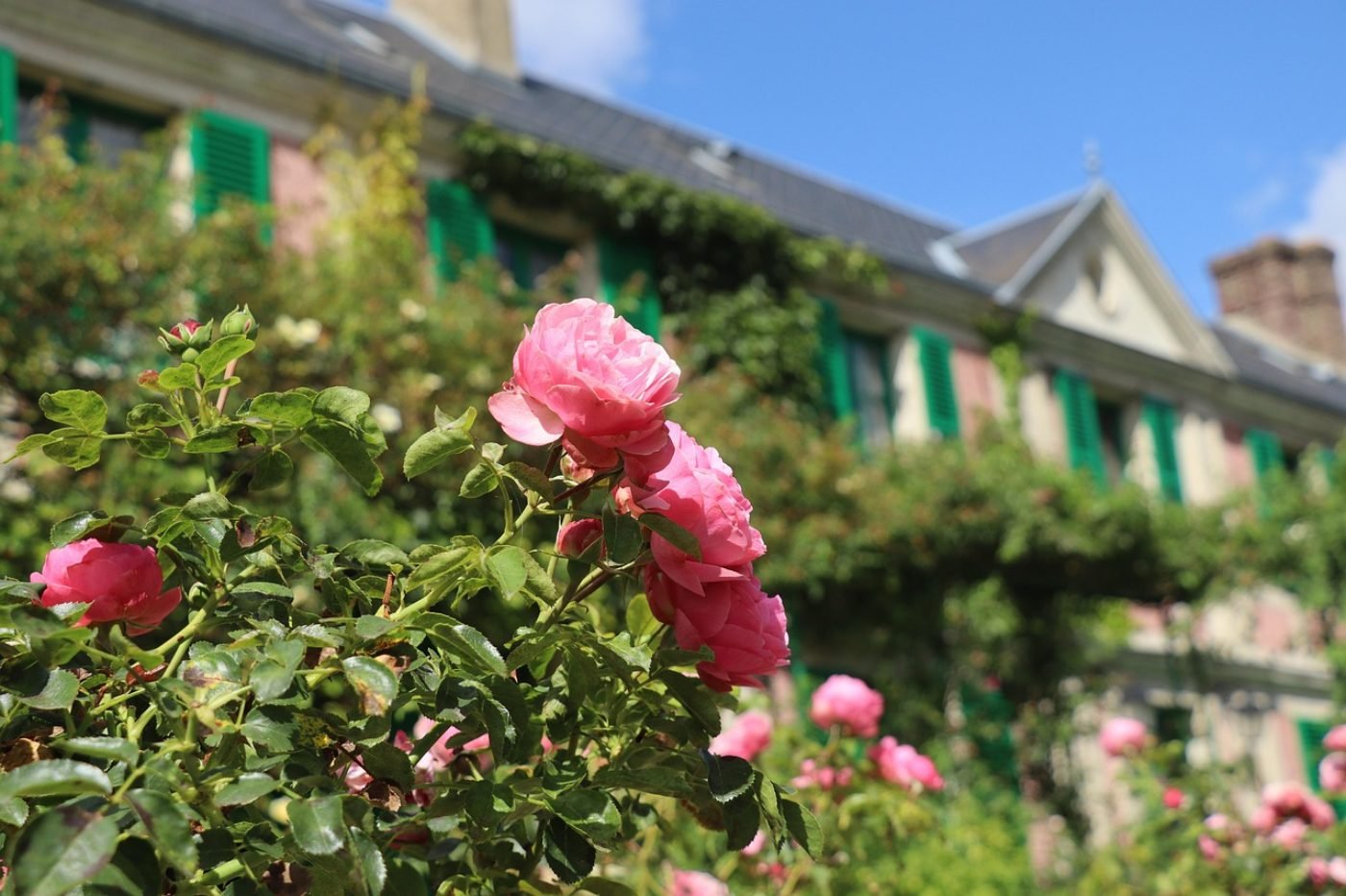
The house is a long, low building, painted pink with green shutters—a combination Monet chose himself and one that’s been immortalized in many photos from the era. Inside, it’s been restored to look as it did when the painter lived there, with original furniture, Japanese prints on the walls, and the famous blue-and-white kitchen seen in historical records.
Monet had a huge collection of Japanese prints—Hiroshige, Hokusai, Utamaro—and they directly influenced the design of the water garden with its Japanese bridge. Seeing those prints on the house’s walls and then walking out to the bridge is an experience that closes a circle in a very clear way.
The studio is separate from the main house. It’s where Monet worked on the large canvases of the Nymphéas—the water lilies—now on display at the Musée de l’Orangerie in Paris. The space was built with high windows specifically to capture natural northern light, without direct sun reflections. It’s a detail that only makes sense when you’re inside the studio and notice the direction of the windows.
The Two Gardens of Giverny
The estate has two separate gardens, each with its own personality. To explore both at a leisurely pace, set aside at least two hours. Anyone who tries to do it in less time leaves feeling like they missed something.
The Clos Normand
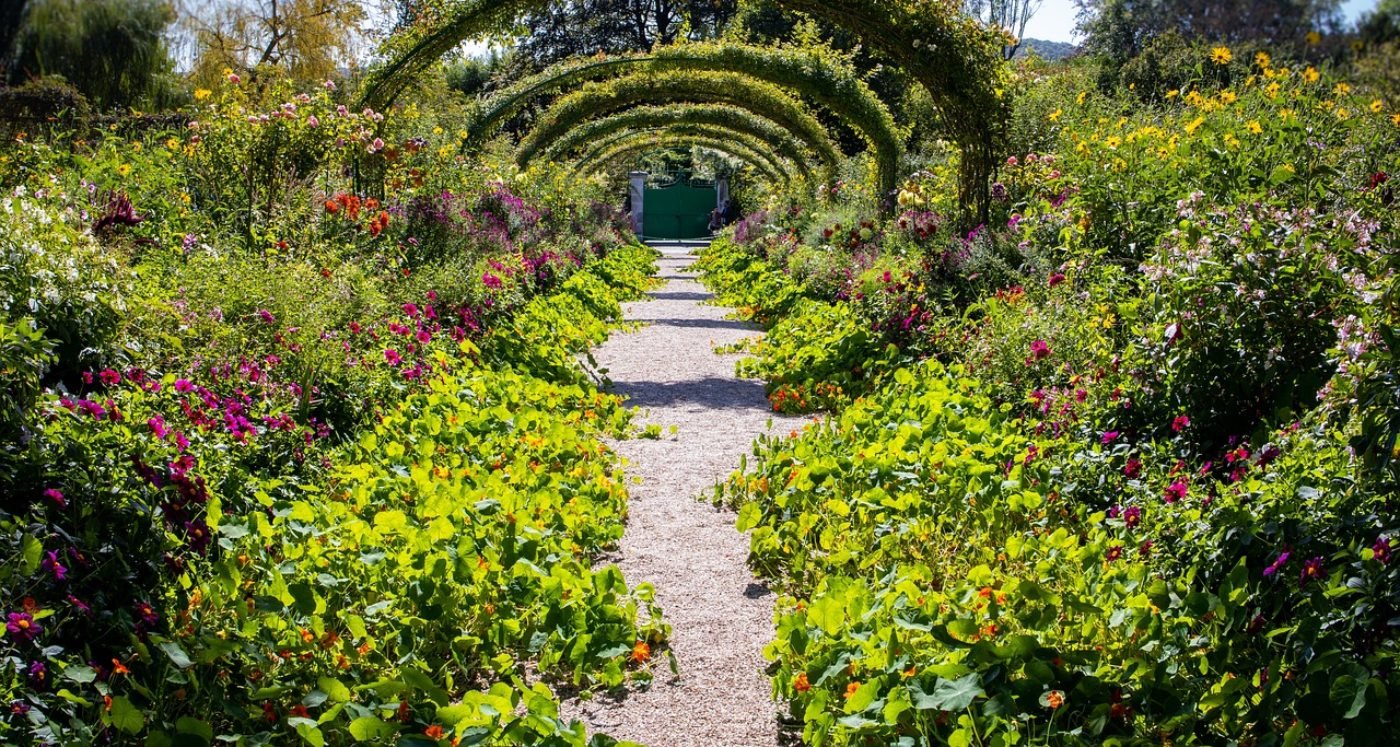
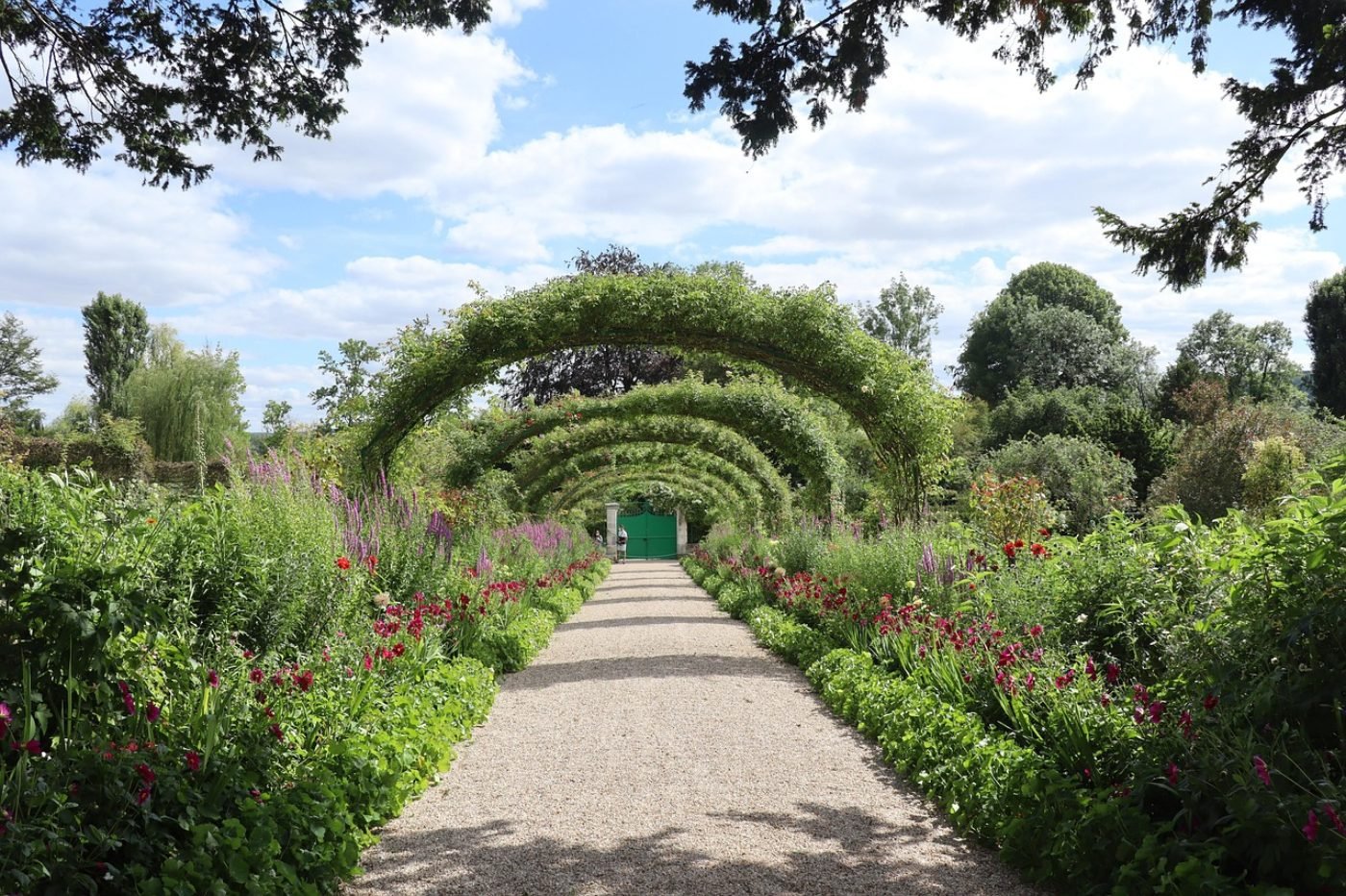
This is the garden in front of the house. The name refers to the Norman style of enclosed gardens, but what Monet did here is far from formal. Flowers grow in long beds, separated by narrow paths covered by metal arches wrapped in climbing roses. At the height of summer, these arches are so covered that you walk practically inside a tunnel of flowers.
Monet organized colors as if he were arranging a palette—warm tones on one side, cool on the other, with gradations in between. He would go so far as to have flowers pulled out if they didn’t match the season’s color scheme. For him, the garden was as serious as any canvas.
The Water Garden and the Japanese Bridge
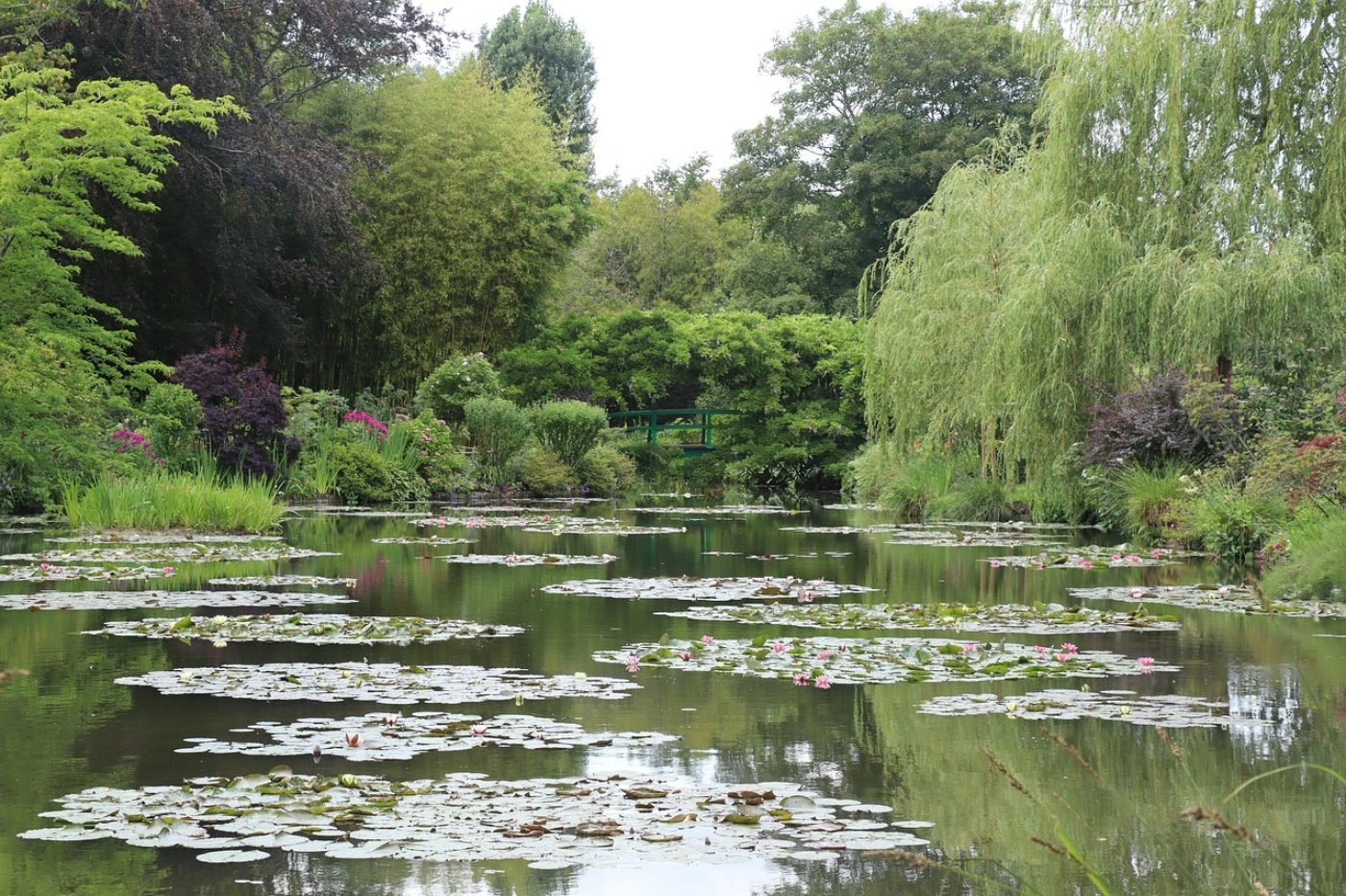
On the other side of the road that cuts through the property—accessed via a tunnel underneath—lies the water garden. This is the space that produced Monet’s most famous works. The artificial pond, fed by a branch of the Epte River, has water lilies growing on its surface and is surrounded by weeping willows, bamboo, and wisteria that cascade over the famous Japanese bridge.
The bridge itself is smaller than most people imagine after seeing the paintings. But the whole scene—the pond, the surrounding plants, and the light that changes with the time of day—delivers exactly that feeling of being inside a Monet painting. It’s not an exaggeration—it’s literally the setting he painted dozens of times.
Early in the morning, when the mist still hangs over the pond and the light is diffused, the water garden has an almost unreal quality. Many photographers arrive before the official opening to try and capture this moment. If you’re visiting, it’s worth the effort to get there early—besides the light, the place is still uncrowded.
How to Get to Giverny from Paris
There’s no metro or RER line to Giverny. The nearest town with a train station is Vernon, about 3 miles from the village. The trip from Paris is on the line departing from Gare Saint-Lazare, with an average travel time of 1 hour and 15 minutes. Trains are frequent on spring and summer weekends, which is Giverny’s high season.
From Vernon to Giverny, you have three main options:
- Seasonal bus: During visiting months (April to October), a bus connects Vernon station directly to the garden entrance. It’s the most affordable and convenient option for those without a car.
- Rental bike: Several rental shops are near the station. The route is flat and pleasant, following the Seine River for much of the way. Many people prefer to bike one way and take the bus back, or vice versa.
- Taxi or rideshare: More expensive, but convenient if you’re with small children or want to avoid the sun. The trip is quick—less than ten minutes.
If you prefer to drive, take the A13 autoroute from Paris towards Normandy and exit at Vernon. There’s paid parking near the garden entrance. Another very popular option is full-day tours from Paris, which combine Giverny with the Seine Valley or other regional attractions—you can find options with or without guides, at various price points.
Opening Hours and Tickets
Monet’s House and Gardens are open from mid-March to early November. Outside this window, the site is completely closed—plan your visit within this period. During peak months (May, June, and September), buy your ticket online in advance, because the on-site line can eat up time you’d rather spend in the gardens.
The ticket grants access to both the house and the two gardens. Young children (usually up to age 7) enter for free. Students and people with disabilities get a discount upon presentation of ID. Exact prices are posted on the official Fondation Claude Monet website and can vary between seasons.
Opening time is usually 9:30 AM, and closing time is 6:00 PM, with last entry around 5:30 PM. These hours can change on specific dates—it’s worth confirming before you go.
Best Time to Visit Giverny
Each season has a strong case. But if you’re only going once and want maximum visual impact, May and June are the most recommended months. That’s when the Clos Normand is in full color explosion—roses, irises, poppies, ageratums—and the water garden pond starts to get covered in water lilies.
July and August have more tourists, but the gardens are also at their peak. September cools down a bit and the flowers change, but Normandy’s early autumn creates a different palette—more golden, more tranquil. April brings tulips and daffodils, with fewer people than summer, but the weather can be unpredictable. Bring a jacket and don’t count on sunshine.
Practical Tips for Making the Most of Your Visit
Arrive early. This is the most repeated tip from those who’ve been, and it’s repeated for good reason: during peak hours, the Japanese bridge is packed with people trying to take the same photo. Getting there within the first 30 minutes after opening, you’ll find the garden much quieter, and the morning light is great for photos.
There’s no café or restaurant inside the complex. Outside, on rue Claude Monet, there are a few options for lunch and snacks. The little town of Giverny has just one main street, but it has enough cafés and restaurants for a meal before or after your visit.
The souvenir shop is at the garden exit and has good art books, posters, and quality reproductions. If you’re a fan of the Nymphéas, this is the place to pick up a more elaborate keepsake.
Comfortable shoes are a must. The garden terrain has pebbles and packed dirt. High heels will be a problem. Flip-flops aren’t ideal on rainy days either.
Giverny and the Musée d’Orsay: The Perfect Pair
Combining Giverny with a visit to the Musée d’Orsay is one of the most satisfying itineraries Paris and its surroundings have to offer. The d’Orsay houses one of the world’s largest collections of Impressionist paintings—with major works by Monet, but also by Renoir, Pissarro, Sisley, and Degas, painted during the same period Giverny’s gardens were being created.
Seeing a Monet painting in the museum and then going to Giverny—or the other way around—is an experience that goes beyond ordinary tourism. You understand where the brushstrokes came from, why the light changes so dramatically depending on the time of day, and how a garden can generate one of the most famous series of paintings in art history.
To dive even deeper into the Nymphéas, the Musée de l’Orangerie in Paris has the large canvases installed in the oval rooms Monet specifically designed for them. The two Paris museums together with Giverny form what many call the “complete Monet itinerary”—and it’s a great way to structure a few days in and around Paris.
Conclusion: Giverny Is Worth the Detour
Giverny is one of those places that delivers more than it promises. You go expecting a pretty garden and a decent museum, and you leave feeling like you’ve understood something about art, about patience, and about what a human being can create when they have enough time, space, and obsession.
The fact that Monet built this place for himself—not for tourists, not for posterity—is what gives the visit a different quality from other tourist attractions. You’re walking through the garden he wanted to see from his window while he painted. That’s a rare experience.