Dica: Aproveite também para fazer estes passeios em Paris
Tour pelo exterior da catedral de Notre Dame + Ingresso da cripta . Duração: 2 horas
Disneyland Paris Duração: 3 horas ou mais
Passeio de barco pelo Sena. Duração: 1h
Ingresso do 3º andar da Torre Eiffel. Duração: 2 a 3 horas
Ingresso do Palácio de Versalhes. Duração: 2 a 3 horas
Veja mais passeio em Paris aqui.
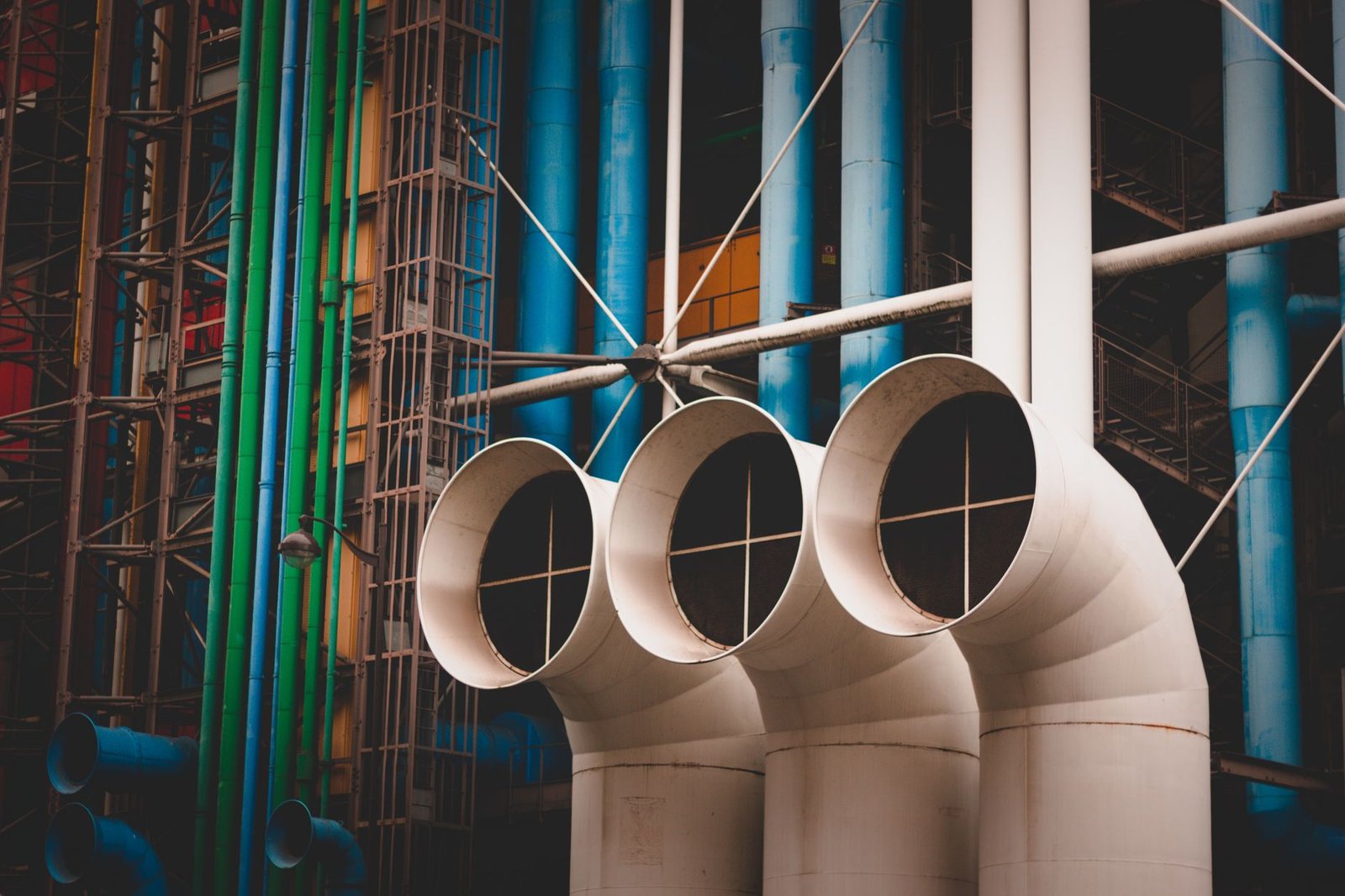
When you first step in front of the Centre Pompidou, it’s impossible not to be taken aback. Not because it’s beautiful—that’s debatable. But because it’s absolutely unlike anything else around it in the Parisian landscape. Colorful pipes on the facade, exposed metal structure—it looks like someone dropped an industrial engineering blueprint right in the middle of historic Paris. Many Parisians hate it. Many tourists love the audacity. And after you get to know it, you understand why this building is one of the most important in the history of modern architecture. Let’s explore the Centre Pompidou, uncover its secrets, and find out if it’s really worth including on your trip.
What Is the Centre Pompidou? The Story of a Revolutionary Architecture
The Centre Pompidou (full name: Centre national d’art et de culture Georges-Pompidou) is a museum of modern and contemporary art that has been open since 1977 in Paris. But calling it “just a museum” is underselling its importance. This place is a massive cultural institution that changed the concept of what a public building should look like.
The story begins in 1969, when French President Georges Pompidou launched an international competition to create an innovative cultural center. The goal? To create a space that wasn’t elitist or closed off, but open, democratic, and one that spoke to everyday people. They wanted to break the idea that museums are only for intellectuals and that art is something removed from daily life.
Out of 370 proposals, the winners were architects Renzo Piano (Italian) and Richard Rogers (British). Their proposal was radical: put EVERYTHING on the outside of the building. The ventilation pipes, the steel structure, the escalators—none of the smooth, discreet walls. The interior would be completely free, with no support pillars. It’s as if they said, “Let’s flip the logic of construction. Here, the technical functions are the decoration. Engineering is art.”
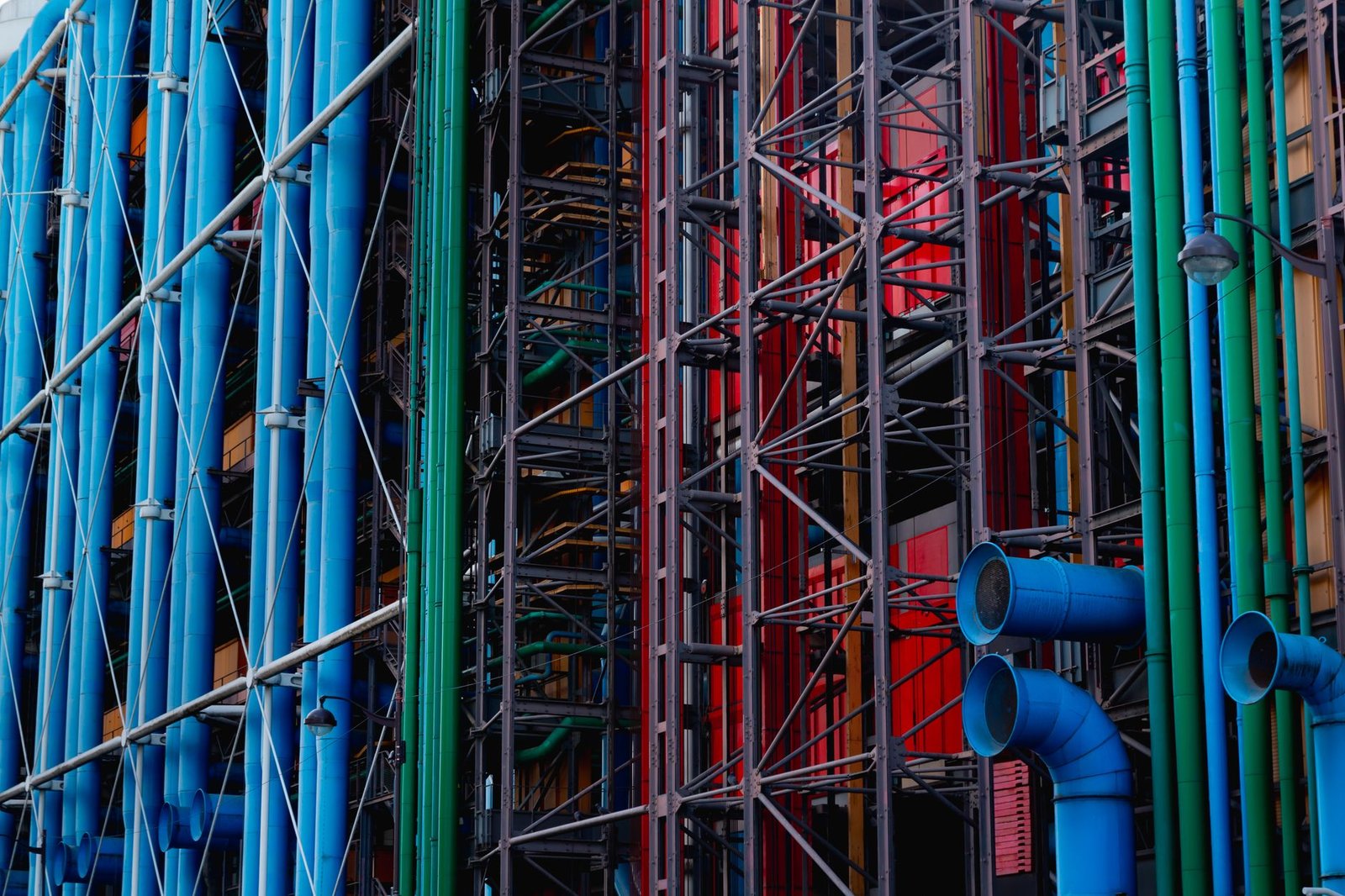
The pipes are color-coded: blue for air, red for water, green for cooling water, and yellow for electrical current. It’s like seeing the building’s DNA exposed. When the structure was completed in 1977, there was a massive scandal. Traditional Parisians called it a “refinery” or “factory.” Architecture critics questioned whether this was really art. Fifty years later, it’s a UNESCO World Heritage site, an international icon of industrial design, and one of the most visited buildings in Paris.
The Collection: World-Class Modern and Contemporary Art
Inside this futuristic shell lies one of the world’s largest collections of modern art. The Museum of Modern Art (Musée d’Art Moderne et d’Art Contemporain) inside the Centre Pompidou covers everything from the period of 1905 to contemporary works created just a few months ago. That’s over 60,000 pieces.
You’ll see masterpieces by Picasso (“Les Demoiselles d’Avignon”), Matisse (“The King’s Sadness”), Kandinsky (“Composition VIII”), Dalí, Warhol, Basquiat, and Brazilian and Latin American artists too. The curation is impressive—it’s not just about “collecting” famous paintings, but telling the story of modern art through them, connecting movements, and explaining how one artist influenced another.
The galleries are organized thematically: Cubism, Surrealism, Abstractionism, Pop Art, Contemporary Art, and so on. You can see how Picasso evolved over decades. How Matisse cut paper at the end of his life (his “découpes”)—a simple yet deeply sophisticated technique. The temporary exhibitions are regularly refreshed every 3-4 months, so even if you come back, there’s always something new to discover.
Beyond the visual art museum, the Centre Pompidou houses: the Public Library (BPI)—completely free, with access to computers, WiFi, and educational resources; IRCAM (Institute for Research and Coordination in Acoustics/Music)—an experimental lab for electronic and contemporary music; Cinemas and theaters—showing alternative films, documentaries, and experimental works; a specialized bookstore—books on art, design, architecture, and photography; and a cafeteria—with a partial view of the city and reasonable prices for Paris.
The space is so vast that you can spend hours here without getting bored. Some people come to the Library and spend the whole day. The structure is organized over 6 main floors, each with a different focus.
The Viewpoint: The Best View of Paris That Few People Know About
One of Paris’s best-kept secrets is on the 6th floor of the Centre Pompidou. The “viewpoint” (actually, the open outdoor area) offers a 360-degree view of Paris that is absolutely breathtaking. Unlike the Eiffel Tower (packed all the time) or Sacré-Coeur (also crowded), this view is less known, therefore less crowded—you can actually breathe, walk around, sit down, and take it all in.
You can see all the major landmarks: the Eiffel Tower in the distance (to the left), Notre-Dame straight ahead, Sacré-Coeur in Montmartre (at the top right), the Panthéon, the Luxembourg Gardens, and the Seine River snaking through the city. All from a unique perspective you can’t get from any other spot in Paris. And the best part? It’s completely free if you have a museum ticket—you take the elevator up, step out onto the 6th-floor plaza, and there it is.
The best time for this experience is at dusk (golden hour), when Paris’s golden light hits the building facades and everything takes on a magical glow. Arrive around 5 PM in the summer (or 3 PM in the winter), stay for at least an hour until sunset, then head down to the cafeteria or grab a drink (yes, there’s a small bar) and keep sipping with that stunning view as your backdrop. It’s an experience that costs only the price of a museum ticket and is worth every penny.
Tip: bring a decent camera or a phone with a good camera. The photos from here turn out incredible, especially if you can snap them in the late afternoon. Paris sunsets from this spot are legendary among photographers.
How to Visit: Hours, Prices, and Tickets Explained
Opening Hours: Tuesday to Sunday: 11 AM to 9 PM (Thursday open until 11 PM); Monday: CLOSED (very important—don’t go on Monday!); Last entry: 1 hour before closing; Special days: may close for private events (rare).
Prices (approximate values in euros, 2026): Full ticket (museum + all exhibitions): €15 (adults); Reduced ticket (13-25 years old, students, teachers, unemployed): €12; Children under 13: FREE; First Sunday of the month: FREE for the museum (WARNING: very, very crowded!); Public Library (BPI): FREE (no ticket required); Viewpoint (6th floor): FREE with museum ticket.
How to buy tickets: Online at the official website (www.centrepompidou.fr)—HIGHLY recommended to skip box office lines; At the on-site box office (there may be waits); International credit/debit card; Paris Museum Pass (if you bought the integrated pass—it covers entry).
Important tip about the Paris Museum Pass: If you’re visiting Paris and plan to enter 2-3 museums over 2-4 days, the Paris Museum Pass is much cheaper (€48 for 2 days, €62 for 4 days) and includes the Centre Pompidou, Louvre, Musée d’Orsay, Versailles, and 50+ other attractions. Plus, it gives you skip-the-line access—you don’t wait in the box office lines.
Detailed Practical Tips for Your Visit
How much time should you dedicate? Minimum 1.5 hours: enter, go up to the viewpoint, leave. Very rushed. Ideal 3-4 hours: explore the museum well, go up to the viewpoint at dusk, grab a drink. For contemporary art fans: a full day (6+ hours) is barely enough.
Best time and day to go: Tuesday and Wednesday mornings (10:30 AM-12 PM) are generally less crowded. Thursday evening (museum open until 11 PM) is great because the city is calmer, fewer tourists. Fridays and Saturdays are chaotic. Absolutely avoid weekends, holidays, and the first Monday of the month.
Anti-line strategy: The entrance is outside, on the Place Beaubourg, so there’s even a line just to get a ticket. If you buy online, there’s a separate entrance (skip-the-line). I HIGHLY recommend buying in advance—it costs €1-2 more, but saves you 30-40 minutes.
Where to leave backpacks and coats: There’s a free and secure luggage storage on the 1st floor. You can leave coats, large backpacks, etc. Small bags can go in without a problem.
Accessibility and mobility: The building is fully wheelchair accessible. There are large, spacious elevators. A mom with a stroller can get around without any issues. Baby changing facilities are available.
Food and drink: There’s a cafeteria on the 6th floor (with a view, of course)—it’s pricey but worth the experience. On the 1st floor, there are coffee and drink machines. I recommend eating something substantial before entering or bringing a snack. There aren’t many food options inside (the cafeteria isn’t a full restaurant).
Is It Worth It? An Honest Pros and Cons Analysis
PROS: Unique and historically important architecture that MUST be seen in person (photos don’t do it justice); World-class modern art collection—genuinely important works from history; 360° viewpoint of Paris, less crowded than the Eiffel Tower; Fewer tourists than the Louvre or Musée d’Orsay—a calmer experience; Lots of free stuff (Public Library, viewpoint with ticket); Diverse, high-quality cultural programming (films, performances, lectures); Incredible space for photography—futuristic design contrasting with historic Paris; Fair price compared to other major attractions.
CONS: The €15 ticket isn’t cheap (but not expensive compared to the Louvre at €17 or the Eiffel Tower at €25); Very crowded during high season and on weekends; If you don’t like modern/contemporary art, it might not be worth your time; First Sunday of the month is free but way too crowded—I don’t recommend it; Some temporary exhibitions might not appeal if you’re expecting “classical” art; The metal structure gets cold quickly on cloudy days—bring a jacket.
In short: if you’re interested in architecture, design, or modern art, it’s a must-see. If you’re short on time in Paris and only plan to see “the classics” (Eiffel Tower, Louvre, Notre-Dame), you can skip it without regret—but you’d be missing out on something genuinely special.
Frequently Asked Questions About the Centre Pompidou
Can I get in for free? Yes! The Public Library (BPI) on the 1st and 2nd floors is completely free, no ticket needed. The viewpoint (6th floor) is free if you have a museum ticket. The first Sunday of the month, the museum is free, but it gets extremely crowded—thousands of people.
How long will my visit actually take? If you just want to “see it” (go to the Library, see it from outside, go up to the viewpoint): 2-3 hours. If you want to explore the museum well: 4-5 hours. If you love art: a full day.
Are there guided tours in English or Portuguese? Yes, in French and English. They cost €15-20 on top of the ticket. Book online on the website. They’re useful if you want to learn the history of modern art structured by an expert.
Can I bring backpacks and large bags? Small bags, yes. Large backpacks or suitcases need to go to the luggage storage (free and secure).
What’s the best time of year to visit? Spring (April-May) and fall (September-October) offer the best weather, less heat, and fewer tourists than summer. Summer is very touristy. Winter might have closures for renovations, but it’s calmer if it’s open.
Is the Paris Museum Pass worth it? If you’re visiting 2+ museums in 2-4 days (Centre Pompidou, Louvre, Musée d’Orsay, Versailles, etc.), YES. It costs €48 (2 days) or €62 (4 days) and skips the line at all of them—saving you time and stress.
Why This Museum Matters Beyond Its Walls
The Centre Pompidou isn’t just a beautiful building or a place to see paintings. It’s a statement of principles. When it was built in 1977, it said: “Art doesn’t have to be complex, mysterious, or isolated. It can be open, public, integrated into the urban landscape, even a little ‘ugly’ or provocative.” It broke down psychological barriers between high art and everyday people who thought museums “weren’t for them.”
The architecture itself is a work of art. That exposed structure, those colorful pipes, the deliberate “ugliness”—it was all a conceptual revolution. Piano and Rogers weren’t trying to compete with Paris’s classical beauty. They were questioning what beauty and function even mean. Today, many modern public buildings draw inspiration from this concept of “form follows function, but make the function visible and even celebrate it.”
Conclusion: Should It Be on Your Itinerary?
The Centre Pompidou is definitely a destination that deserves a spot on your Paris itinerary, especially if you appreciate architecture, design, or contemporary art. Even if you’re not a huge fan of modern art, the view from the 6th floor, the architectural structure itself, and the free Public Library are worth a visit. It’s unlike anything else you’ll see in Paris, it’s provocative, and it’s legitimately important to the cultural history—not just of Paris, but of world architecture.
Set aside 3-4 hours, buy your ticket online to avoid unnecessary lines, go on a Tuesday or Wednesday if possible, and end your visit at sunset on the viewpoint with a drink in hand. You’ll understand why, fifty years after its construction, despite all the debate and initial controversy, this building remains an icon that Paris can’t live without. It’s provocative, it’s modern, it’s different—exactly as Paris should be.