Some people wrinkle their nose just hearing about it, but the Paris Catacombs are among the most talked-about experiences for anyone returning from the French capital. And it’s no exaggeration: down there, about 65 feet underground, lie the remains of over six million people, arranged in narrow stone corridors. If you’re thinking about taking on this offbeat itinerary, it’s worth understanding what to expect, how much it costs, and whether it’s really worth the time (and the line).
Dica: Aproveite também para fazer estes passeios em Paris
Tour pelo exterior da catedral de Notre Dame + Ingresso da cripta . Duração: 2 horas
Disneyland Paris Duração: 3 horas ou mais
Passeio de barco pelo Sena. Duração: 1h
Ingresso do 3º andar da Torre Eiffel. Duração: 2 a 3 horas
Ingresso do Palácio de Versalhes. Duração: 2 a 3 horas
Veja mais passeio em Paris aqui.
What Are the Paris Catacombs?
The Catacombs occupy part of an ancient network of underground quarries, excavated since Roman times to extract the limestone used in building the city. Over time, these tunnels were forgotten — until, at the end of the 18th century, Paris faced a serious problem: the cemeteries in the city center were so full that the walls of mass graves collapsed, contaminating neighboring basements.
The solution authorities found was to transfer the bones to these abandoned galleries. Between 1786 and 1788, in nightly processions with priests and carts, millions of bones from the Cemetery of the Innocents and other Parisian cemeteries were taken there. Later, someone had the idea of arranging everything decoratively — rows of femurs and skulls forming patterns, some even in the shape of hearts or crosses.
The result is an ossuary that opened for public visits as early as the beginning of the 19th century, becoming one of the most peculiar (and oldest organized tourist attractions) in the city.
How to Get There and Buy Tickets
The official entrance is at Place Denfert-Rochereau, at the southern exit of the metro (lines 4 and 6), in the 14th arrondissement — much further south than the classic Eiffel Tower/Louvre circuit, so set aside travel time.
Tickets need to be purchased well in advance on the official website (catacombes.paris.fr). The walk-up line without a reservation often stretches 1.5 to 2 hours, especially in high season, and on many days of the year, tickets sell out days ahead. There are options with an audioguide (recommended, since there are hardly any explanations on the signs) and slightly more expensive “skip the line” tickets, which are worth it if you couldn’t book ahead.
Tip from someone who’s been through the experience: set your visit date as soon as you book your trip and buy the ticket right away — this is the kind of outing that can throw off your whole itinerary if left to the last minute.
What You’ll Find Inside
The visit starts with a spiral staircase of 131 steps that descends into the tunnels — you can already feel the temperature dropping, staying around 57°F (14°C) year-round, so a light jacket helps a lot even on hot days above ground.
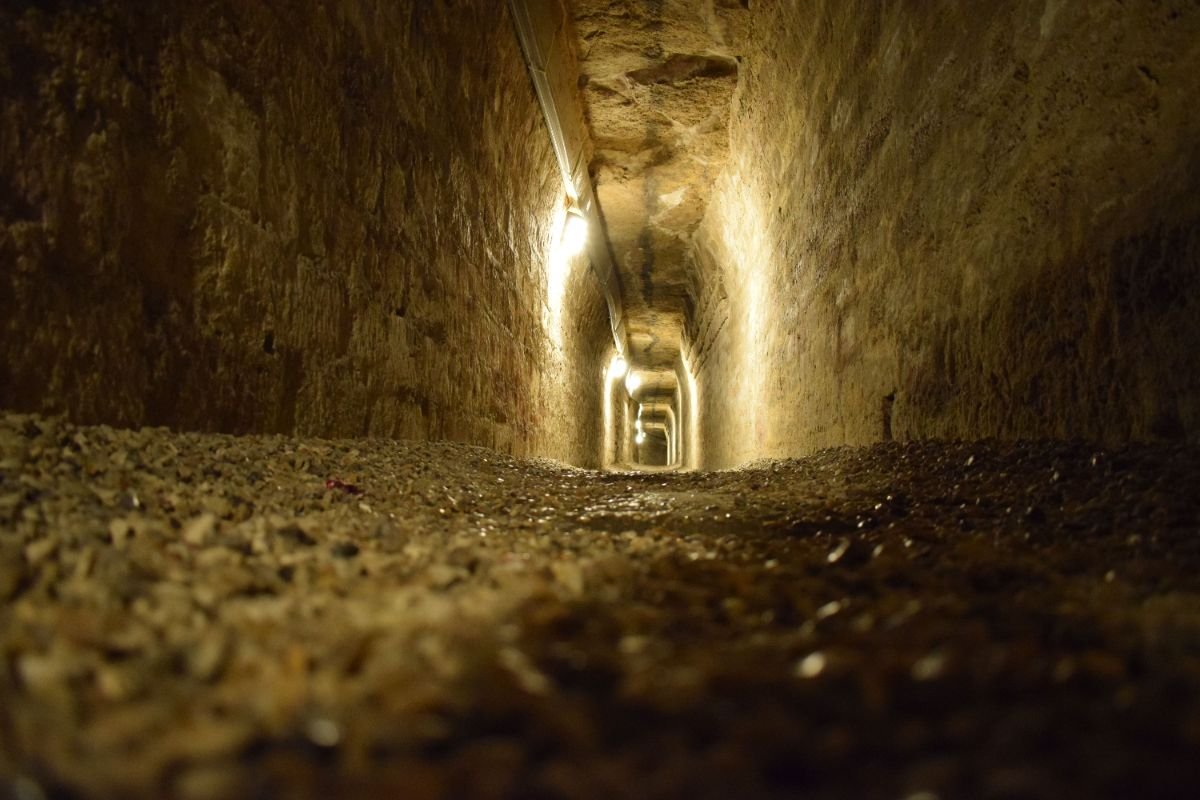
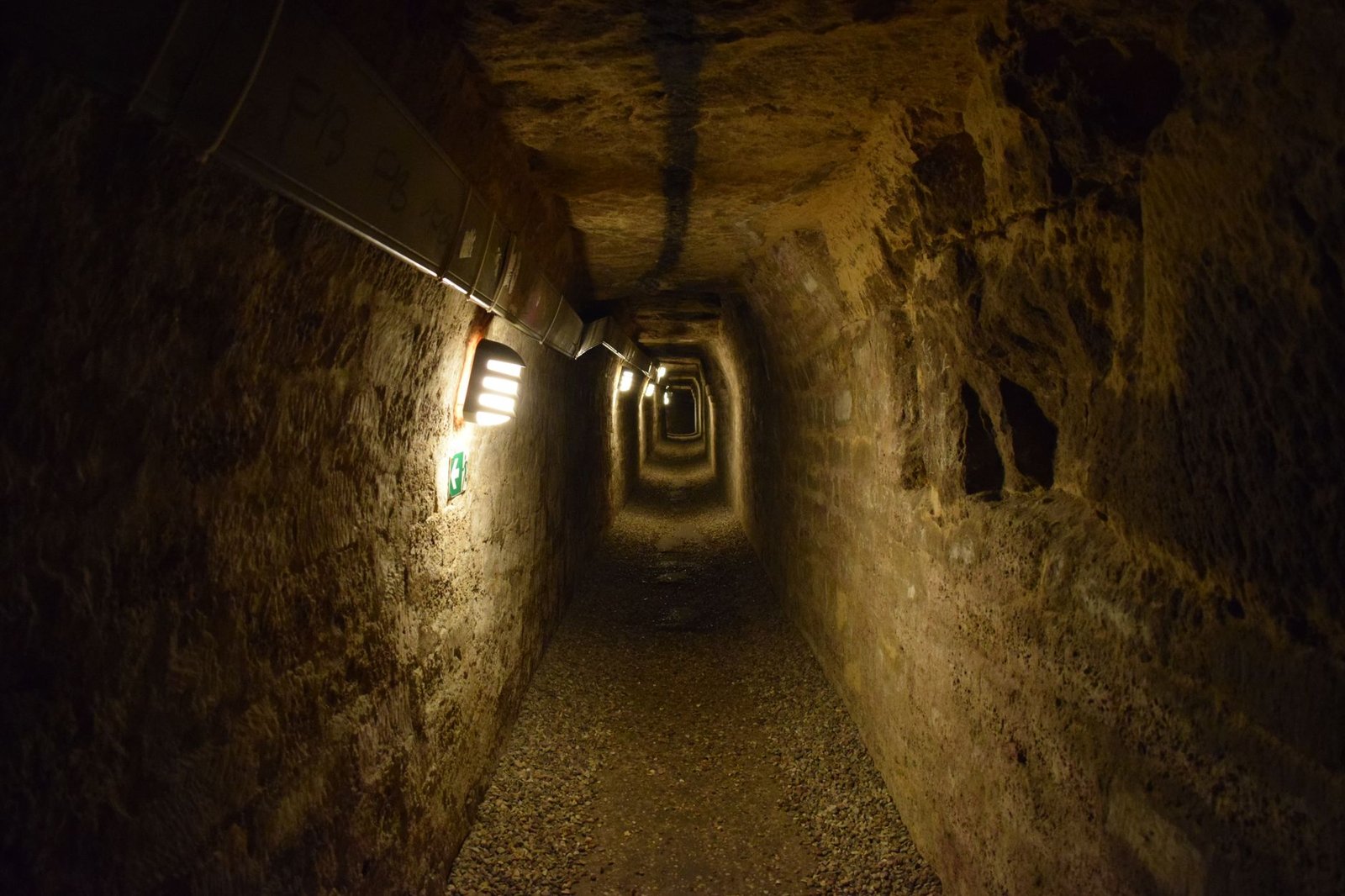
The route is about 0.9 miles of narrow, low-ceilinged corridors, passing through old quarries before reaching the ossuary itself. That’s where you’ll see the famous sign at the entrance: “Arrête! C’est ici l’empire de la Mort” (Stop! This is the empire of death) — a warning that already sets the tone for what’s to come.
Inside the ossuary, entire walls are made of organized bones, with plaques indicating which cemetery (and from what era) those remains came from. It’s not a place for scares or haunted house effects — it’s silent, cold, and much more somber than many people imagine, more like visiting a memorial than a spooky attraction.
At the end, you have to climb another staircase (112 steps) that exits at a very different spot from where you entered, just a few blocks from the original entrance. There’s a bag check system at the exit — back in the day, this was created to prevent visitors from “taking souvenirs” of the bones, and the rule remains to this day.

Little-Known Facts About the Catacombs
The tunnels that make up the Catacombs are just a small fraction of a much larger network of ancient underground quarries that spread beneath Paris — it’s estimated that this web of galleries stretches for hundreds of miles, though only about 0.9 miles is open to the public.
For decades, these “unofficial” tunnels were the territory of a group known as cataphiles: people who enter through hidden gaps around the city to explore areas closed to the public, sometimes organizing parties, art exhibitions, or just nighttime strolls. The practice is illegal and risky (there have been cases of people getting lost for days), but it fuels much of the mysterious imagination surrounding the place.
Another curiosity: during World War II, parts of this tunnel network were used by both the French Resistance and, in another section, by German troops, who even built an underground bunker nearby. And, of course, over the centuries, stories have multiplied (most unsubstantiated) about secret passages linking the Catacombs to important city buildings.
Best Time and Season to Visit
Since the circuit is underground, the experience doesn’t change much between summer and winter in terms of “scenery” — but visitor traffic does. During high season (June to August, and also the holiday season), demand for time slots is usually much higher, and tickets can sell out further in advance.
If you can choose, go for the earliest time slots, right at opening. Besides facing shorter lines (even with a reserved ticket, there’s always a small wait at the entrance), you’ll finish the tour with the morning still free to continue your itinerary through the rest of the 14th arrondissement, which has cafes and quiet streets very different from the tourist center.
Practical Tips to Keep Your Visit Smooth
- Book in advance: in high season (European summer, December/January), time slots can sell out 1 to 2 weeks ahead.
- Use the restroom before you go: there are no bathrooms along the route, and the visit lasts between 45 minutes and 1 hour.
- Bring a light jacket: the constant 57°F (14°C) catches many people off guard, especially on hot summer days outside.
- Comfortable shoes: the floor is uneven and damp in some sections, and there are plenty of stairs.
- Not recommended for those with severe claustrophobia, heart conditions, or advanced pregnancy — the official website even discourages visiting in these cases.
- Large backpacks may need to be left in a luggage storage area — bring only the essentials.
- Photos without flash are generally allowed, but it’s worth checking the day’s signage, as rules change from time to time.

Is Visiting the Paris Catacombs Worth It?
It depends on your travel style. If you love history, off-the-beaten-path places, and don’t mind the idea of walking among bones organized over 200 years ago, it’s absolutely worth it — it’s an experience few cities in the world offer, and it tells a real part of Paris’s history that doesn’t show up on postcards.
On the other hand, if your itinerary is already tight and you’d rather prioritize museums, shopping, or the classic spots (Eiffel Tower, Louvre, Champs-Élysées), the Catacombs can wait for a future trip without much loss — it’s a complement, not a must-see for someone in Paris for just a few days.
A tip for families traveling with kids: very young children often don’t enjoy it much (and the closed, cold, dimly lit environment can scare some); for curious teenagers and adults interested in history, it’s often one of the trip’s highlights.
Frequently Asked Questions About the Paris Catacombs
How much does a ticket to the Paris Catacombs cost?
The price varies by ticket type (standard entry, with audioguide, or priority access) and typically ranges from €15 to €30 per person. Since prices change frequently, it’s best to check the current rate directly on the official website before finalizing your itinerary.
Do I need to book in advance?
Yes, and this is perhaps the most important tip in this guide. Online booking is practically mandatory for anyone who doesn’t want to waste hours in line or risk not getting in on their desired day.
Are the Catacombs suitable for children?
There’s no official age restriction, but the environment — dark, cold, with narrow stairs and millions of exposed bones — is generally not recommended for young children. Families with older, history-curious kids tend to have a good experience.
How long does the visit to the Catacombs take?
On average, between 45 minutes and 1 hour of continuous walking, with no places to sit or pause along the route. Add to that the waiting time (even with a reserved ticket, there’s usually a short wait) and the trip to the entrance at Place Denfert-Rochereau.
Do I need to be physically fit to visit?
The route involves two spiral staircases (131 steps down and 112 up) and about 0.9 miles of walking through narrow corridors. It’s not an exhausting outing, but people with reduced mobility or difficulty climbing stairs may struggle, as there’s no elevator.
Can I visit the Catacombs on my own, or only with a guide?
You can visit on your own, following the marked route with the help of an audioguide (recommended, since explanatory signs are quite scarce). There are also guided group tours in English or French for those who prefer someone to provide context live — worth considering, especially if you’re traveling with someone very interested in history.
Is there access for people with reduced mobility?
Unfortunately, no. The route depends on the two spiral staircases (entrance and exit), and there’s no elevator or alternative path — which is why the official website is clear in recommending that people with mobility difficulties, heart or respiratory conditions avoid the visit. It’s worth considering this point before including the outing in your itinerary, especially if you’re traveling with someone with mobility restrictions.
Is it worth combining the Catacombs with another outing on the same day?
You can combine them, but take it easy. After nearly an hour in a closed, cold environment, most visitors leave wanting to walk outdoors — which is why many people take the opportunity to walk to a nearby park or café, and leave the rest of the “heavier” itinerary (museums, long lines) for another part of the day. Squeezing two equally intense outings back-to-back tends to make the day too tiring.
In the end, the Paris Catacombs are one of those experiences that divide opinions before the visit and almost always impress afterward. If it fits your itinerary and your style, it’s worth booking your ticket in advance and setting aside a morning or afternoon for this very different side of Paris, far from the postcards.