Palace of Versailles: The Ultimate Guide for a Perfect Visit
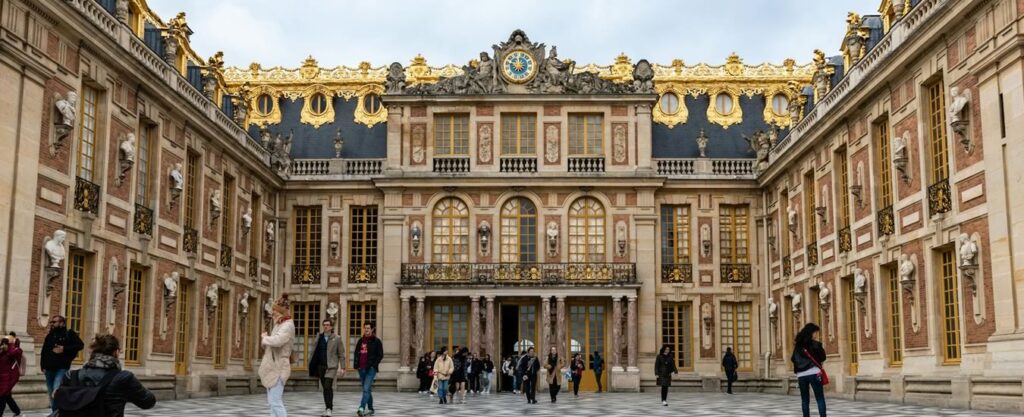
🇧🇷 POR | 🇫🇷 FR | 🇺🇸 EN | 🇪🇸 ES Imagine walking through the same gilded corridors that French kings and queens strolled centuries ago. The morning sun reflects off the 357 mirrors of the breathtaking Hall of Mirrors, while the immaculate gardens stretch as far as the eye can see. This isn’t a dream—it’s the Palace of Versailles, one of France’s most visited monuments, welcoming over 8 million tourists annually. For many travelers, however, a visit to the Palace of Versailles can be frustrating: endless lines, confusing ticket information, and the feeling of missing the most important parts of the complex are common issues. But don’t worry—this guide is designed to turn your visit into a truly royal experience. Tip: make the most of your trip to Paris and check out the Arc de Triomphe; Here you’ll discover everything from the palace’s historical secrets to the practical tips only experts know to make the most of every moment at Versailles. Ready to explore this world heritage site in an unforgettable way? Let’s begin our journey through the ultimate symbol of French absolutism. History and Significance of the Palace of Versailles The Palace of Versailles is more than just a building—it’s a living chapter of European history. Originally, it was a modest hunting lodge built by King Louis XIII in 1623. It was his son, Louis XIV, known as the “Sun King,” who transformed Versailles into the magnificent complex we know today. Between 1661 and 1715, Louis XIV dramatically expanded the palace, turning it into the official seat of the French government and the ultimate symbol of his power. The monarch had a clear vision: to create a monument that would intimidate foreign visitors and centralize the French nobility under his watchful eye. “L’État, c’est moi” (I am the state), his famous phrase, is embodied in the architectural grandeur of Versailles. The palace witnessed crucial historical events, including the signing of the Treaty of Versailles in 1919, which officially ended World War I. During the French Revolution, the royal family was forced to leave Versailles in 1789, marking the end of an era of monarchical extravagance. Today, the Palace of Versailles has been a UNESCO World Heritage Site since 1979, recognized not only for its architectural beauty but for its invaluable historical significance. Every corridor, hall, and garden tells a story of power, art, and social transformation that continues to fascinate visitors from around the world. The Architecture That Inspired the World The architectural style of Versailles became a benchmark for royal palaces across Europe. Architects Jules Hardouin-Mansart and Louis Le Vau, along with landscape designer André Le Nôtre, created a perfect balance between grandeur and refinement. The main facade of the palace stretches an impressive 580 meters, making it one of the longest in Europe. The extensive use of marble, gold, and mirrors wasn’t just decorative—it visually communicated the economic and political power of France under Louis XIV. Interestingly, many elements of Versailles were specifically designed to create optical illusions. The gardens, for example, were laid out with forced perspectives to appear even more expansive when viewed from the palace windows. What Not to Miss at the Palace of Versailles Versailles is immense—with over 700 rooms spread across 63,154 square meters, it’s impossible to see everything in a single visit. Here are the must-see attractions that justify its worldwide fame: The Royal Apartments The king’s and queen’s apartments represent the ceremonial heart of the palace. Louis XIV’s bedroom, with its elaborately decorated bed under a gilded canopy, was the setting for daily rituals like the “lever” (waking) and “coucher” (retiring) of the king—moments when courtiers vied for the honor of watching the monarch dress or prepare for sleep. The queen’s apartments, equally luxurious, were where queens gave birth in public, ensuring the legitimacy of the royal heir. The silk-lined walls and intricately carved furniture demonstrate the artistic sophistication of the era. The Hall of Mirrors Undoubtedly the most famous room in Versailles, the Galerie des Glaces (Hall of Mirrors) stretches 73 meters and represents the pinnacle of Baroque luxury. The 357 mirrors arranged in 17 arches face windows opening onto the gardens, creating a dazzling interplay between natural light and reflections. This hall wasn’t just a passageway—it was where important state ceremonies took place. It was here that the German Empire was proclaimed in 1871 after the Franco-Prussian War, and where the Treaty of Versailles was signed in 1919. The lighting in this hall is strategic: at dusk, when hundreds of candles were lit, the mirrors multiplied the light, creating a shimmering effect that amazed visitors—a true demonstration of French technical and artistic mastery. The Gardens and Fountains of Versailles The gardens of Versailles are as impressive as the palace itself. Designed by André Le Nôtre, they cover 800 hectares and represent the perfection of the formal French garden—symmetrical, geometric, and completely dominating nature. The 55 fountains and 600 water jets are a masterpiece of 17th-century hydraulic engineering. During the “Musical Fountains Shows” (Grandes Eaux Musicales), all the fountains operate simultaneously to the sound of Baroque music—a spectacle dating back to the time of Louis XIV. Highlights include: Be sure to explore the gardens with a plan: the fountains operate at specific times, and walking through the park can take several hours. The Grand Trianon and Petit Trianon To escape the rigid etiquette of the court, French monarchs built smaller residences on the palace grounds. The Grand Trianon, with its characteristic pink stone, was built by Louis XIV as a retreat for discreet meetings with his mistress, Madame de Montespan. The Petit Trianon, a gift from Louis XV to Madame de Pompadour, became the refuge of Queen Marie Antoinette. Here, she had the Queen’s Hamlet (Le Hameau de la Reine) built—a cluster of rustic cottages where she could play at being a peasant, a fantasy that contributed to her unpopularity during the Revolution. Less visited than the main palace, these buildings offer a more intimate experience and reveal fascinating aspects of the private
How to Get to the Palace of Versailles from Paris
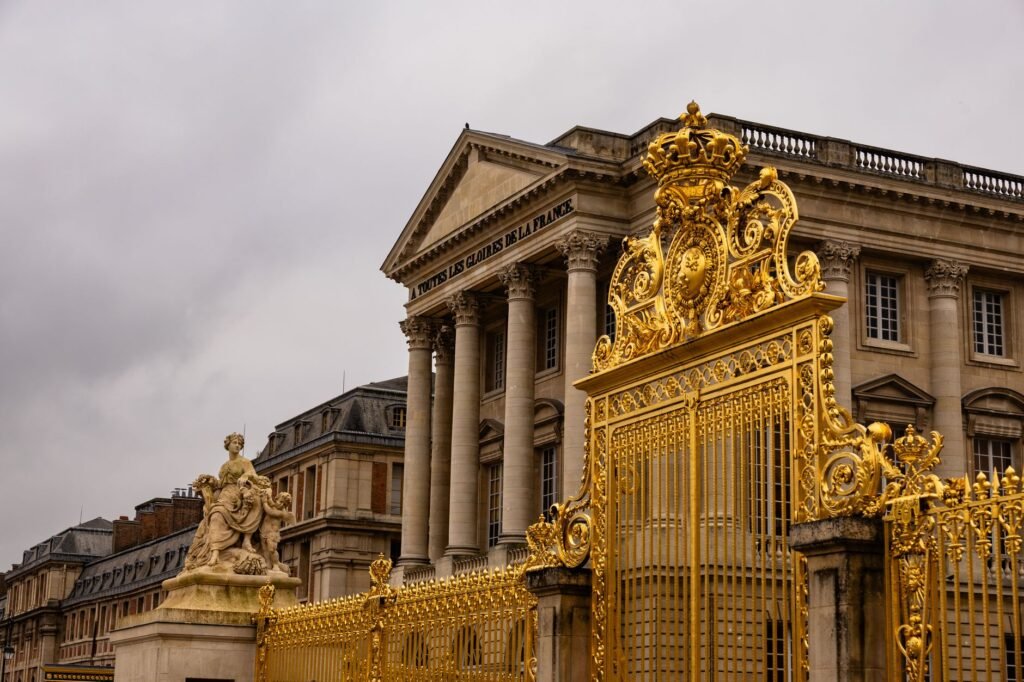
🇧🇷 POR | 🇫🇷 FR | 🇺🇸 EN | 🇪🇸 ES Versailles is less than an hour from central Paris, but the trip has its pitfalls: there are two stations with similar names, at least three different ways to get there, and a stretch on foot that trips up first-timers. This guide cuts through the noise, no detours. The golden gate of the Cour d’Honneur is the arrival point for those walking from the train station. | Photo: Siva Seshappan / Pexels RER C: The most popular option from Paris The RER C is the most direct route. It departs from stations like Invalides, Musée d’Orsay, Saint-Michel Notre-Dame, and Javel, and ends at Versailles Château Rive Gauche station — which, as the name suggests, is the closest to the palace. The trip takes between 35 and 45 minutes, depending on where you board. Pay attention to a detail that trips up a lot of people: not all trains on the C line go all the way to Versailles Château Rive Gauche. Some terminate earlier at Versailles Chantiers, which is farther from the palace and requires a much longer walk. Check the platform board or the app to make sure the train is indeed the “Versailles Château Rive Gauche” before you board — the full destination name usually shows up on the train’s information screen. Once you leave the station, the walk to the palace’s main gate takes about 5 to 10 minutes, pretty much in a straight line — just follow the flow of tourists, which is usually easy to spot at any time of day. During peak hours, the RER C platforms get packed — arriving a few minutes early helps you catch the right train. | Photo: Léa Claisse / Pexels Transilien from Saint-Lazare: The less crowded alternative If you’re staying near Gare Saint-Lazare or just want to avoid the RER C crowds, there’s a second option: the Transilien L train, which leaves from Saint-Lazare and arrives at Versailles Rive Droite station. The travel time is similar, between 35 and 40 minutes, but this station is a bit farther from the palace — the walk increases to 15 to 20 minutes. In practice, this route is worth choosing if your accommodation is closer to Saint-Lazare than to the RER C stations, or if you simply prefer a train that’s generally less crowded during busy hours. How much it costs: What changed with the fare reform Until recently, getting to Versailles cost more than a trip within Paris because the city is in zone 4 of the metropolitan area. That’s changed. Since the Île-de-France Mobilités fare reform, the single metro-train-RER ticket costs the same for any trip within the region — no matter how many zones you cross. In practice, this means that going to Versailles now costs the same as taking the metro from one neighborhood to another inside Paris: a single ticket (around €2, with slight variations depending on the type of pass you use) covers the entire trip, with no extra charge for crossing zones. If you already have a weekly or monthly Navigo pass, you don’t even need to think about it — the trip is included. From the station to the entrance: Where to go When you exit Versailles Château Rive Gauche station, signs for the château appear right at the exit. The path goes down a short commercial street before opening up into the large square in front of the golden gate — the same one you see in almost every photo of Versailles online. If you’re coming from Versailles Rive Droite station, the route is a bit longer, cutting through part of the city center of Versailles before reaching the same square. It’s not a difficult path to follow, but it’s worth factoring in those extra minutes if you have a timed entry for the palace. The Cour d’Honneur, the grand entrance courtyard, is where both walking routes (RER C and Transilien) converge. | Photo: FREE VIDEO HAPPY / Pexels Quick summary: Which option to choose If your priority is saving money and keeping things simple, the RER C wins hands down — it’s the most direct route, the cheapest since the fare reform, and it drops you closest to the main gate. The Transilien from Saint-Lazare is only worth it if your accommodation is genuinely closer to that station, or if you want to avoid the heavier crowds on the RER C during peak hours. A guided tour makes sense if you’re traveling with a large group, with elderly people or small children, or if you simply don’t want to deal with any logistics — you pay more, but you trade decision-making for convenience. Taxis or ride-sharing apps usually only pay off in specific cases: tight flight connections, heavy luggage, or groups of 4 or more, when the fare split between everyone ends up being similar to the combined train ticket prices. Other ways to get there: Guided tours, taxis, and ride-sharing For those who’d rather not deal with trains, there are organized tours leaving from Paris, usually in vans or tourist buses, with a guide included and tickets already booked. It’s a pricier option, but it handles all the logistics — a good choice if you’re short on time or have mobility issues. Uber and taxis work too, of course. The drive from central Paris usually takes between 40 minutes and 1 hour, depending on traffic — which can get pretty bad during morning rush hour. The cost varies depending on your exact starting point, but it tends to be significantly higher than the train ticket price for the same trip. Important note: Once you get there, it’s worth figuring out what to do inside the palace before you buy your ticket — check out our complete guide to visiting the Palace of Versailles, with tips on hours, prices, and what not to miss in the Hall of Mirrors. Practical tips for the day of your visit Leave Paris early — morning trains fill up