Introduction
Place des Vosges is so much more than just a square in Paris—it’s a peaceful retreat in the heart of the bustling Marais district. With 140 years of history (founded in 1612), this square is the oldest planned square in all of France and remains virtually unchanged since its creation, a rarity in cities that are constantly reinventing themselves.
If you’re planning a trip to Paris, it’s essential to understand why Place des Vosges attracts over 2 million visitors annually. Its charm lies not only in the unique Renaissance architecture with its 36 identical mansions but also in the intimate atmosphere that invites you to leave the city’s rush behind. The square offers an authentic experience: from picnics on the lush green grass, to coffee with a view of the historic arcades, to bookshops and art galleries that transport you back centuries.
Dica: Aproveite também para fazer estes passeios em Paris
Tour pelo exterior da catedral de Notre Dame + Ingresso da cripta . Duração: 2 horas
Disneyland Paris Duração: 3 horas ou mais
Passeio de barco pelo Sena. Duração: 1h
Ingresso do 3º andar da Torre Eiffel. Duração: 2 a 3 horas
Ingresso do Palácio de Versalhes. Duração: 2 a 3 horas
Veja mais passeio em Paris aqui.
In this complete guide, you’ll discover everything you need to know about Place des Vosges: its history, architecture, what to do, where to eat, the best time to visit, and whether it’s truly worth dedicating an entire afternoon to this Parisian icon.
The Fascinating History of Place des Vosges
Place des Vosges is the result of an ambitious 17th-century urban transformation. In 1605, King Henry IV decided to turn a plot of land that once housed a horse market into an elegant square that reflected power and beauty.
Its original name was “Place Royale,” but it was renamed in 1800 to honor the Vosges department, which was the first to pay its taxes during the French Revolution. This name change represents an interesting turning point in French history, marking the transition from a monarchical symbol to a democratic name.
The square was conceived as a symbol of order, symmetry, and progress. Its design was so successful that it served as a model for other squares across Europe. Each of the 36 buildings was constructed with the same height and architecture, creating a visual harmony that persists to this day—making Place des Vosges a rare example of urban cohesion in a city that has changed dramatically over the centuries.
For centuries, the square attracted intellectuals, artists, and notable figures. Victor Hugo passed away in his apartment here. Paris Hilton is said to have visited the square during her youth spent in Paris. This blend of tradition and modernity makes the square a unique symbol of Parisian heritage. For more information on tourism in Paris, visit the Paris Tourism official site.
Architecture and Unique Features
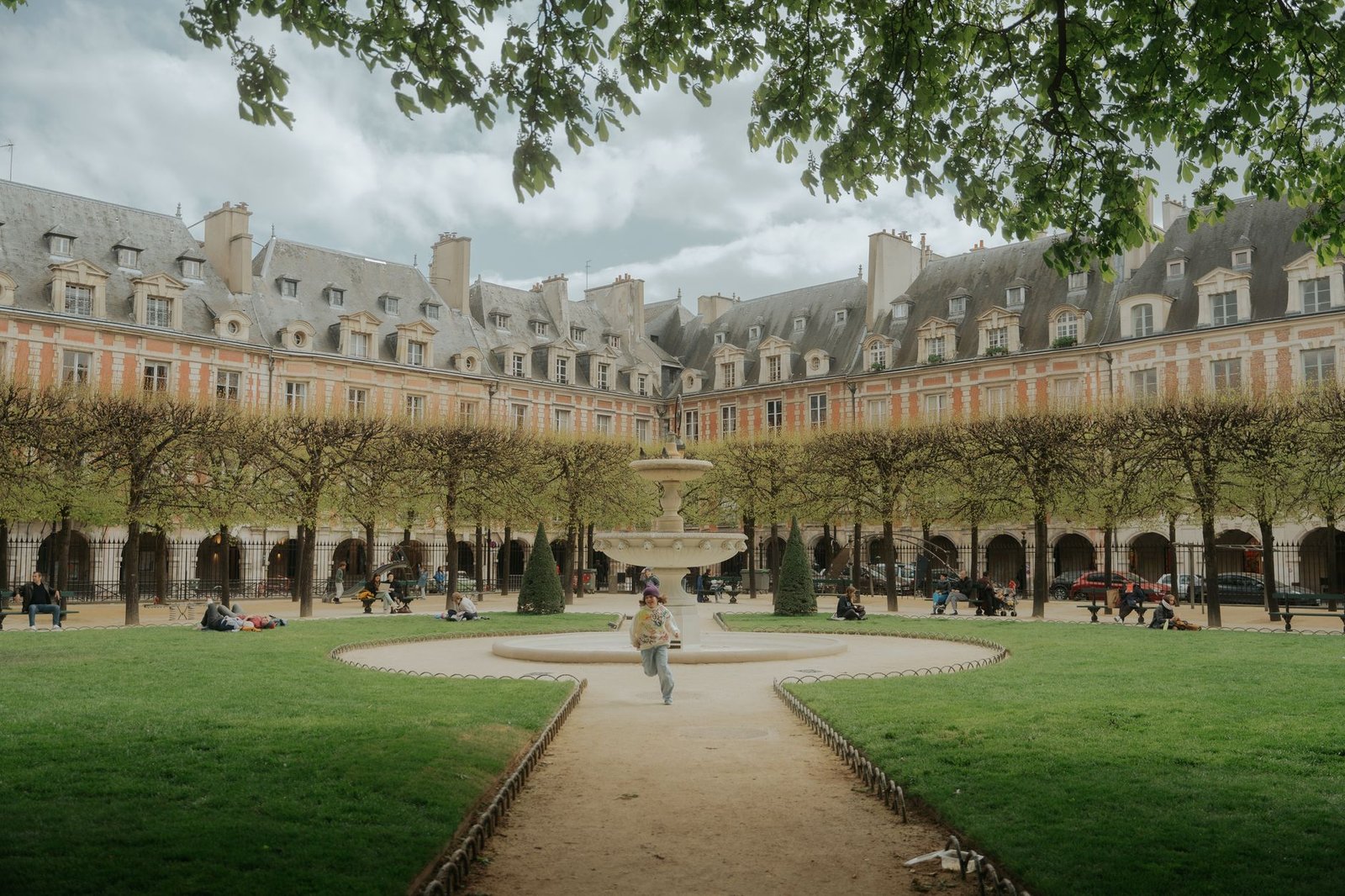
The architecture of Place des Vosges is a masterclass in Renaissance proportion and elegance. The 36 buildings surrounding the square follow a strictly identical pattern: each has four stories, symmetrically arranged windows, and facades of red brick and stone in a checkerboard pattern.
What makes Place des Vosges visually distinctive is its series of arcades—400 arches spanning the entire square that offer shelter from rain and sun while creating shaded spaces perfect for strolling. Under the arcades, you’ll find small shops, restaurants, and art galleries that make the most of this historic space for their businesses.
At the center of the square lies a quadrangular garden spanning approximately 1.4 hectares, filled with centuries-old trees, benches, and lawn. Unlike many Parisian gardens, you’re actually invited to lie down on the grass—something unusual in Paris, where gardens often charge admission or have strict rules.
The proportions are mathematical: 140 meters per side, creating a perfect square shape. This geometric harmony is exactly what makes your digital camera and your eye capture such perfect images. It’s no coincidence that Place des Vosges is one of the most photographed spots in Paris among amateur and professional photographers alike.
What to See at Place des Vosges: Top Attractions
Victor Hugo’s House
The most famous attraction at Place des Vosges is Victor Hugo’s House (Maison de Victor Hugo), located at building number 6. The writer lived there with his family from 1832 to 1848, and it’s here that he worked on many of his most famous works, including parts of “Les Misérables.”
Today, the house is a museum that preserves his personal furniture, original manuscripts, and drawings made by Victor Hugo (he was also a talented visual artist). Admission costs around 7 euros, and you can climb the original wooden stairs that creak beneath your feet—an experience that literally connects you to the past.
Art Galleries
The first floor of the arcades is practically a continuous art gallery. You’ll find everything from contemporary artist studios to galleries selling high-value works. Many are open to the public during the day, and several feature works by emerging artists.
The Galerie Lavignes-Bastille is especially known for showcasing modern art and photography. The Galerie des Trois Mondes offers works by international artists.
Shops and Boutiques
Place des Vosges attracts an exclusive selection of boutiques, from fashion stores to specialized bookshops. Merci is a Belgian concept store that functions as a bookstore, design shop, and café all at once—perfect for anyone looking to dive into culture while picking up sophisticated gifts.
The Central Green Space
The central garden is truly the heart of Place des Vosges. You can:
- Have a picnic: Bring baguettes, cheeses, and wine from the nearby Rue des Rosiers (the Jewish street of the Marais) and sit on the grass alongside equally enchanted Parisians and tourists
- Read or work: Many people bring laptops and take advantage of public Wi-Fi (or from nearby cafés) to work in one of the most inspiring settings in Paris
- People-watch: The Parisian practice of “flânerie” (aimless strolling) is naturally enhanced here. Sit on a bench and observe unique social patterns
- Take photos: The square offers photogenic angles in virtually every direction
Where to Eat and Drink Around the Square
Restaurants and Cafés Under the Arcades
L’As du Fallafel: Legendary spot on Rue des Rosiers (right next to Place des Vosges) serving the best falafel in Paris. Expect a line, but it’s worth every minute. Approximate price: 8-12 euros.
L’Orangerie: Upscale restaurant under the arcades serving high-end French cuisine. Perfect for a special lunch with a view of the garden. Expect to spend: 35-50 euros per person.
Ma Bourgogne: A local classic, offering traditional French bistro fare. The tables on the arcade provide a prime spot for watching the square while you eat. Price: 18-30 euros.
Merci Bookseller Café: Inside the Merci store, it offers excellent coffee, desserts, and sandwiches. Ideal for a quick break during your stroll.
Gourmet Picnic
Rue des Rosiers, just a 2-minute walk from Place des Vosges, is the best street to assemble your gourmet picnic:
- Sacha Finkelszatj: Jewish deli with eggs in jelly, foie gras pastries, and other traditional items
- Chez Marianne: Small restaurant with authentic Jewish food that also sells takeaway
- Any bakery (“boulangerie”) for fresh bread and croissants
Total cost of a picnic for two: 20-35 euros.
Before You Go: Practical Checklist
| Aspect | Detail |
|---|---|
| Best time to visit | Spring (April-May) or fall (September-October). Summer is hot and very crowded with tourists. Winter offers fewer crowds and more charm |
| How much time to allow | Minimum 1.5-2 hours to explore the square + arcades. With lunch: 3-4 hours. With a visit to Victor Hugo’s House: add 1.5 hours |
| Admission | Entry to the square is free. Victor Hugo’s House: 7 euros. Art galleries: free entry (purchases are optional) |
| Recommended time of day | Early morning (8-9am) to avoid crowds. Or late afternoon (5pm+) when tourists are leaving the square |
| Transportation | Metro lines 1, 5, or 8 to Saint-Paul or Bastille station. The square is a 10-minute walk away |
| What to bring | Picnic blanket if you plan to picnic, camera, sunscreen, hat (little shade in the central garden) |
| Safety tips | Avoid displaying expensive bags under the arcades. Keep an eye on your belongings during a picnic. At night, the square is quieter, but stick to main streets on your way back |
| Best lunch option | Picnic on the grass (more authentic) or L’As du Fallafel on Rue des Rosiers (more Parisian) |
Frequently Asked Questions about Place des Vosges
Q: Is Place des Vosges a good option for families with children?
A: Absolutely! The central garden is safe and full of space for kids to play. Many Parisian families bring their children on weekends. The square offers benches to sit on while you supervise. Victor Hugo’s House might be interesting for older kids, but younger ones might find it dull.
Q: Do I need to buy tickets in advance for Victor Hugo’s House?
A: Not necessarily. The house doesn’t receive many visitors, so there aren’t long lines like at Paris’s major museums. You can show up and enter the same day.
Q: Can I have a picnic at Place des Vosges?
A: Yes! It’s encouraged. The square maintains this casual character. You’ll see locals and tourists eating on the grass throughout the day.
Q: What’s the best angle for photographing Place des Vosges?
A: The best views are: (1) from the first floor of the arcades looking toward the center; (2) from the center of the garden looking toward one side of the arcades; (3) from Rue de Birague (the northwest entrance) to capture perfect symmetry.
Q: How long does it take to visit Victor Hugo’s House?
A: On average, 45 minutes to 1 hour if you want to read the historical information. You can do a quick visit in just 20 minutes by just seeing the rooms.
Q: Is Place des Vosges wheelchair accessible?
A: Partially. The arcades are flat and accessible, but the central garden has some small steps at certain entrances. Contact the local city hall for specific access information.
Is It Worth Visiting?
Yes, it’s absolutely worth it. Place des Vosges offers something most tourist spots in Paris can’t: authenticity blended with history. While the Eiffel Tower is surrounded by crowds and vendors, Place des Vosges maintains a sense of discovery—even though it’s 400 years old.
The square is ideal for those who:
- Want an experience beyond the typical tourist spots
- Appreciate historic architecture and urban design
- Enjoy wandering without pre-planned itineraries
- Want an outdoor picnic in true Parisian style
- Are interested in French literature (Victor Hugo)
- Prefer quality time over quantity of attractions
It’s not essential for those who:
- Only have 1 day in Paris and need to focus on the Eiffel Tower, Louvre, and Notre-Dame
- Don’t speak French and find less “touristy” environments challenging
- Travel with people who have reduced mobility
Conclusion
Place des Vosges isn’t just a geographic location in Paris—it’s a state of mind. When you step into its symmetrical arcades and sit in the central garden, you feel like you’ve traveled back in time to a Paris that hasn’t fundamentally changed in four centuries.
Unlike many tourist spots that exploit visitors and offer generic experiences, Place des Vosges stays true to its essence: a public space where real Parisians come to relax, read, chat, and eat. You’re invited to do the same.
If you’re in the Marais—and we strongly recommend you are, as it’s an unmissable neighborhood in Paris—dedicate an entire afternoon to Place des Vosges. Bring a book, a baguette, and a notebook. Feel the slow rhythm of Parisian life. Photograph the arcades. Sit on the grass. This is the real Paris.
Next steps: After visiting Place des Vosges, explore the Le Marais neighborhood in depth. Visit the historic Rue des Rosiers for Jewish cuisine, wander the narrow streets of the medieval district, and end your afternoon at the Picasso Museum.