Paris has over thirty bridges crossing the Seine, and each one tells a different story. Some are so ornate they look like movie sets; others are discreet, almost invisible to those rushing by. But there are a handful that are worth stopping for, taking a moment to admire, and photographing—because the view they offer, whether of the river, the historic buildings, or the bridge itself, is hard to forget.
This guide features the most beautiful and photographed bridges in Paris, with tips on where to position yourself, the best time to go, and what makes each one special. Most are located along the same walking circuit through the historic center, so you can easily visit three or four in a single day without overdoing it.
Dica: Aproveite também para fazer estes passeios em Paris
Tour pelo exterior da catedral de Notre Dame + Ingresso da cripta . Duração: 2 horas
Disneyland Paris Duração: 3 horas ou mais
Passeio de barco pelo Sena. Duração: 1h
Ingresso do 3º andar da Torre Eiffel. Duração: 2 a 3 horas
Ingresso do Palácio de Versalhes. Duração: 2 a 3 horas
Veja mais passeio em Paris aqui.
Pont Alexandre III: The Most Ornate in Paris
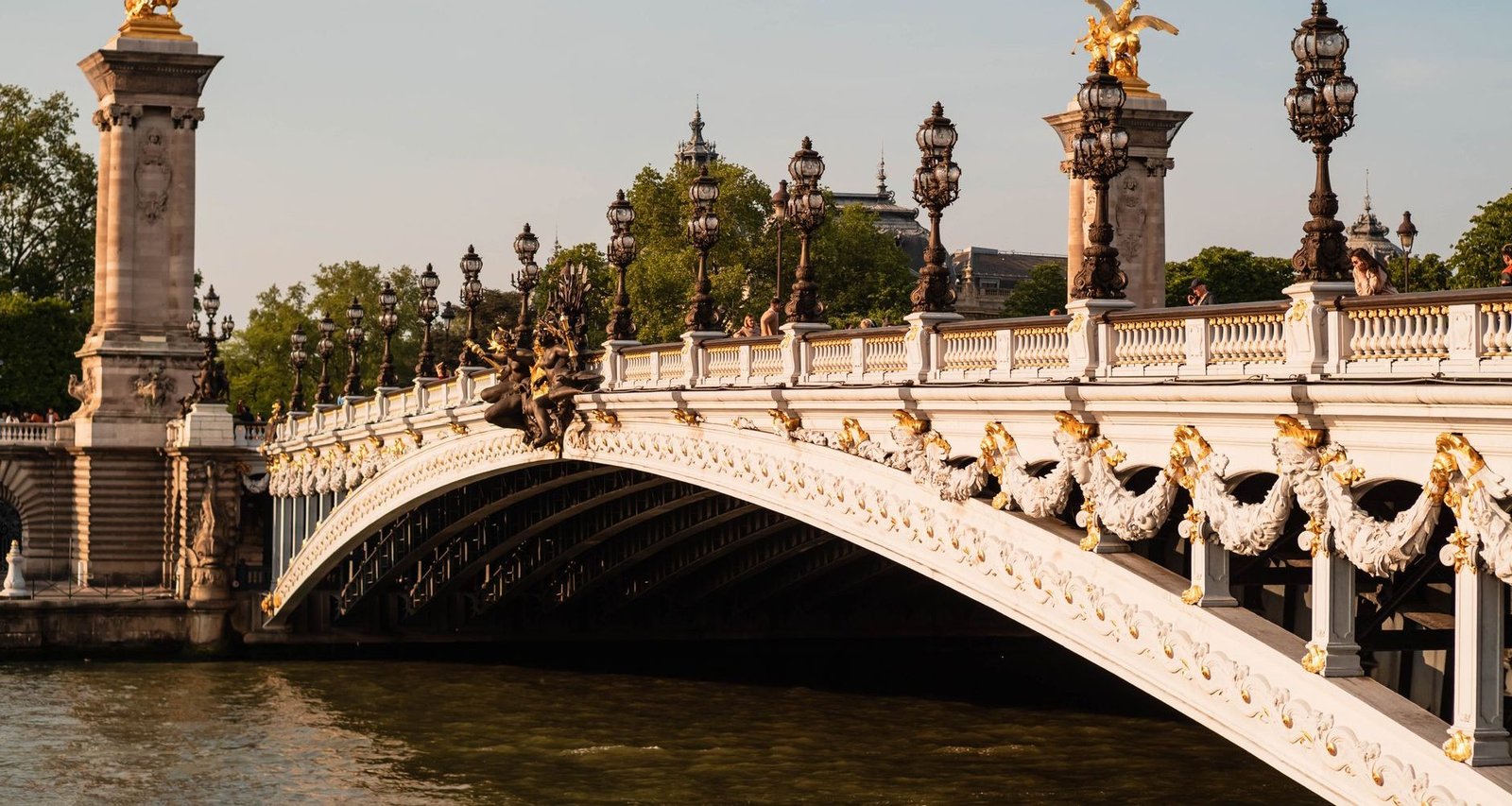
If you could only choose one bridge to photograph in Paris, most people who know the city well would say: Pont Alexandre III. And for good reason. Built between 1896 and 1900 for the 1900 Universal Exposition, it brings together everything Belle Époque architecture did best—stone columns topped with golden statues, ornate lampposts, sculptural groups on its four pillars, and two metal arches spanning the Seine.
What makes photos from here so powerful is the combination of elements. From the bridge, you see Les Invalides behind you and the Grand Palais ahead—three monuments from the same historical period, aligned on an almost perfect visual axis. At the end of the day, when the sun hangs low, the golden statues catch the light in a way that’s hard to replicate on other bridges.
For crowd-free photos, arrive before 8 a.m. The bridge sits on the route for many people traveling between the Left Bank museums and the Champs-Élysées, so it gets busy during the day. At night, with the lighting on the columns and statues, the look is completely different—more sober, more dramatic.
Where it is: between the 7th and 8th arrondissements, easy to combine with a visit to the Musée d’Orsay or the Grand Palais. Nearest metro: Invalides (lines 8 and 13) or Champs-Élysées Clemenceau (line 1).
Pont Neuf: The Oldest, in the Heart of Île de la Cité
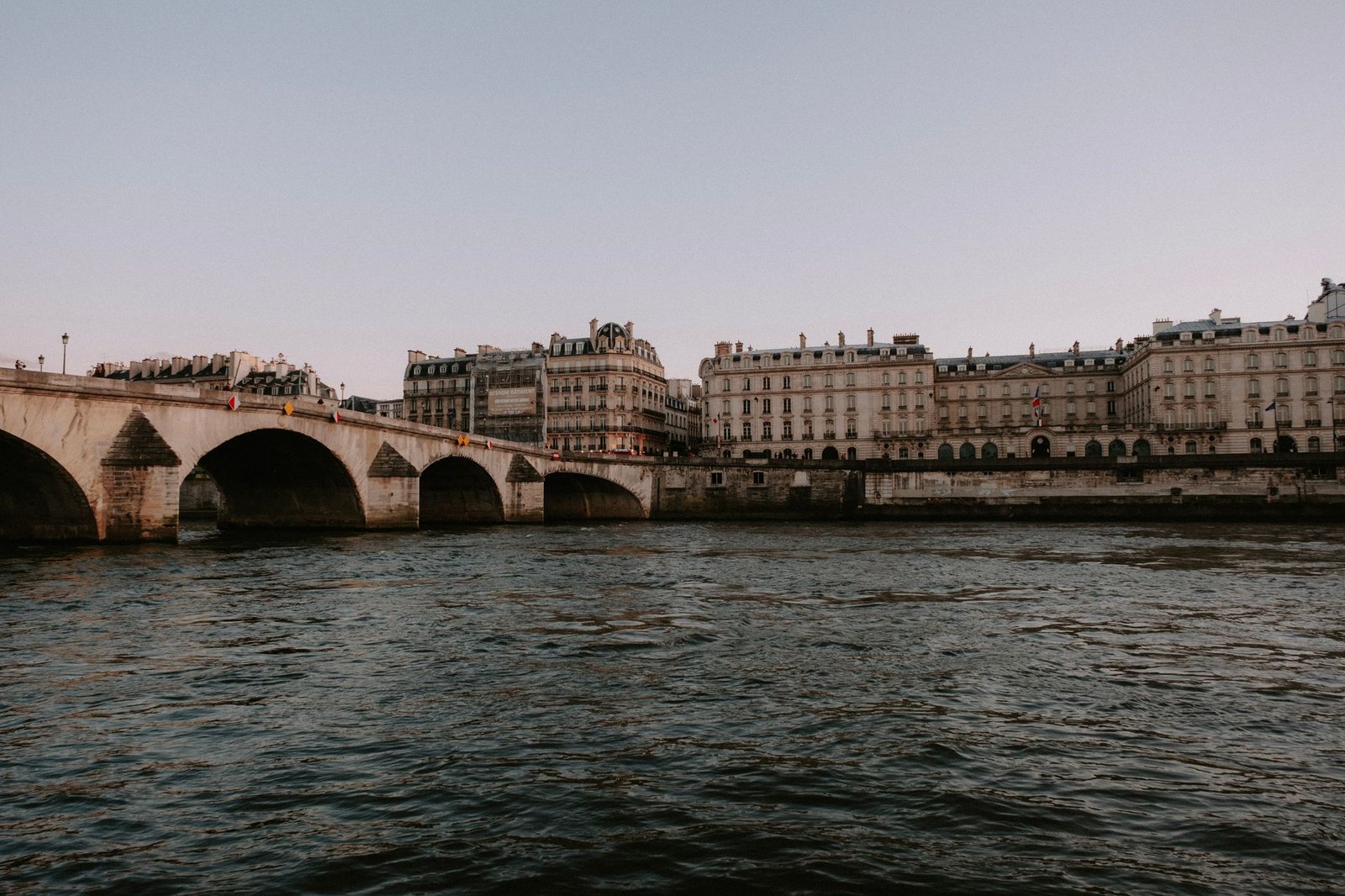
The name is misleading: “Pont Neuf” means “New Bridge,” but it’s the oldest bridge in Paris still in use. Completed in 1607 during the reign of Henry IV, it was the city’s first bridge built without houses on top—an innovation at the time, since medieval bridges also served as commercial streets. Today, the equestrian statue of Henry IV stands in the center of Île de la Cité, right where the bridge’s two sections meet.
What makes it special for photography is its strategic position: it cuts across the western tip of Île de la Cité, offering views in several directions at once—toward the Louvre to the north, the Institut de France to the south, and Sainte-Chapelle just behind. If you stand at the tip of the island and look back at the bridge, you get one of the most classic perspectives of central Paris.
There are also the protruding semicircles on the side of the bridge—called “demi-lunes”—where you can sit and watch the Seine flow below. A surprising quietness in the middle of one of the world’s busiest cities. To see the bridge from below, take one of the stairs down to Square du Vert-Galant, a narrow garden at the island’s tip, almost at water level.
Where it is: at the western tip of Île de la Cité, in the 1st arrondissement. Metro: Pont Neuf (line 7). A 10-minute walk from the Louvre.
Pont des Arts: The Love Lock Bridge
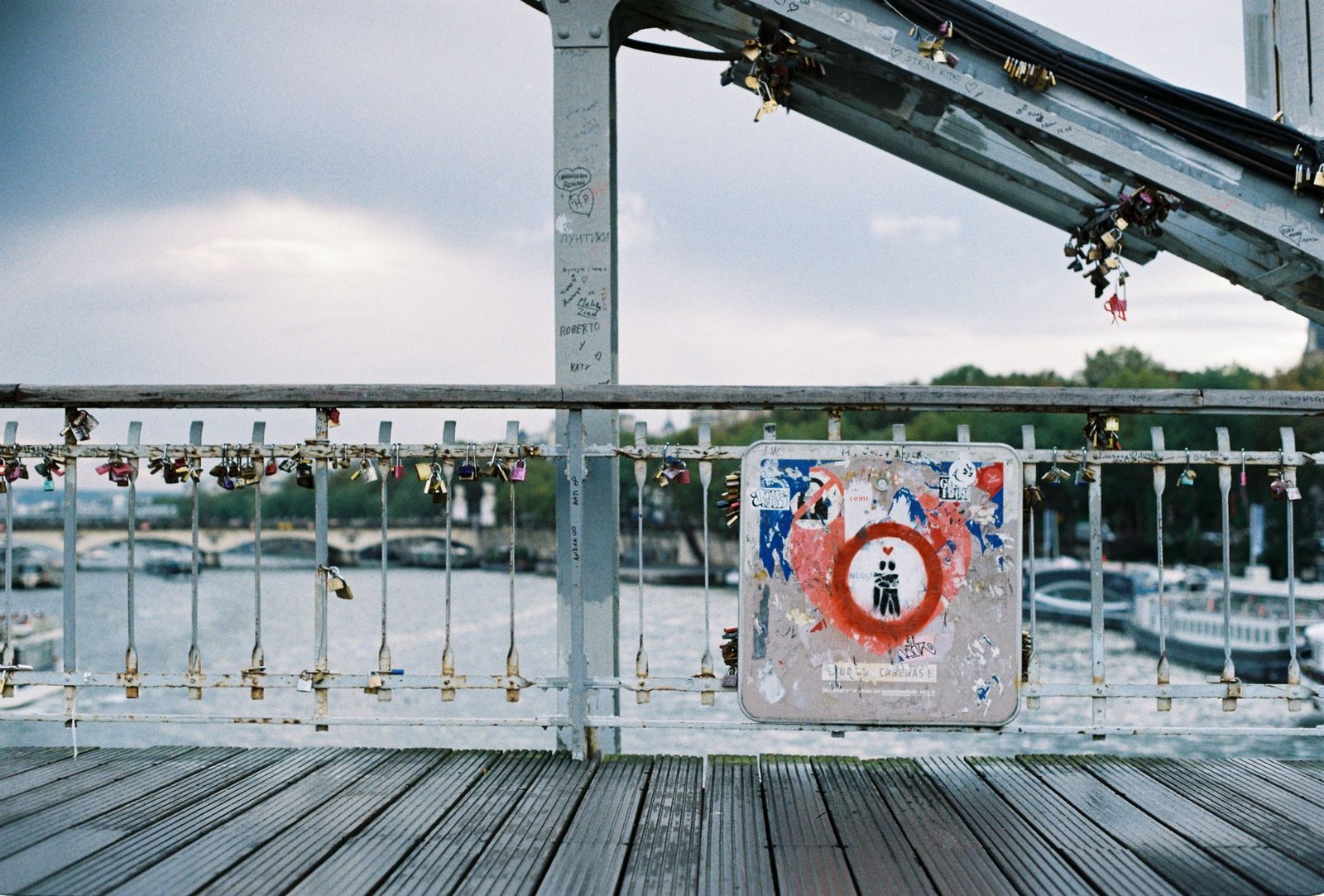
No other bridge in Paris has accumulated as much romantic symbolism as Pont des Arts. For years, couples from around the world came here to attach a padlock to the railing as a symbol of eternal love and throw the key into the Seine. In 2015, after the accumulated weight—estimated at 45 tons—began to threaten the structure, the city removed all the locks and replaced the railings with glass panels.
The controversy sparked debate, but Pont des Arts remains a meeting point. The iron structure, with its seven arches, offers one of the most open views of the Seine in the historic center—the Louvre on one side, the Institut de France on the other, with its green domes reflected in the water. It’s a pedestrian-only walkway, making the stroll here more peaceful than on other bridges shared with cars.
Musicians often set up in the middle of the bridge, especially on summer late afternoons. If you want to photograph the Louvre with a river perspective, this is one of the best angles: position yourself on the north side of the bridge looking east.
Where it is: between the 1st and 6th arrondissements, connecting the Louvre to the Left Bank. Metro: Pont Neuf (line 7) or Saint-Michel (line 4).
Pont de Bir-Hakeim: The Photographer’s Favorite Angle
Less known to the general public, Pont de Bir-Hakeim is perhaps the most beloved spot for photographers and filmmakers in Paris. The structure has two levels: the lower for pedestrians and vehicles, the upper for metro line 6—and it’s exactly this combination that creates unique images. When the metro passes over the upper viaduct with the Eiffel Tower in the background, the result is an urban composition hard to find anywhere else in the city.
Christopher Nolan’s film “Inception” used Pont de Bir-Hakeim in one of its most recognizable scenes. Since then, the spot has become a pilgrimage site for movie fans. But even without knowing that, most people stop at the railing on the lower level and look up—the perspective of the columns and the bridge’s arch creating a corridor toward the Eiffel Tower is unforgettable.
To photograph the metro passing with the Eiffel Tower in the background, stand at the southern end of the bridge, on the pedestrian level, looking northeast. Line 6 runs frequently, so you won’t have to wait long. The best results happen at the end of the day, with the light coming from the southwest.
Where it is: in the 15th and 16th arrondissements, near the Eiffel Tower. Metro: Bir-Hakeim (line 6)—in fact, you get off right on the bridge’s structure itself. A 10-minute walk from the Eiffel Tower.
Pont Mirabeau: Poetry and Tranquility
Less visited than the others, Pont Mirabeau holds a special meaning for those familiar with French literature. Poet Guillaume Apollinaire wrote “Le Pont Mirabeau” in 1913, lamenting the end of a love affair as the Seine flows beneath the bridge and time passes. A plaque with an excerpt from the poem is engraved on one of the structure’s beams.
The bridge sits on a quieter stretch of the river, far from the tourist center, and therefore offers a different experience from the more famous bridges: fewer people, an unobstructed view of the river in both directions, and a stillness that matches the melancholy of the poem that made it famous. For those looking to escape the crowds but still want to photograph the Seine, it’s a great alternative.
Where it is: in the 15th and 16th arrondissements, 2 km from the Eiffel Tower. Metro: Javel (line 10) or Charles Michels (line 10).
Tips for Photographing the Bridges of Paris
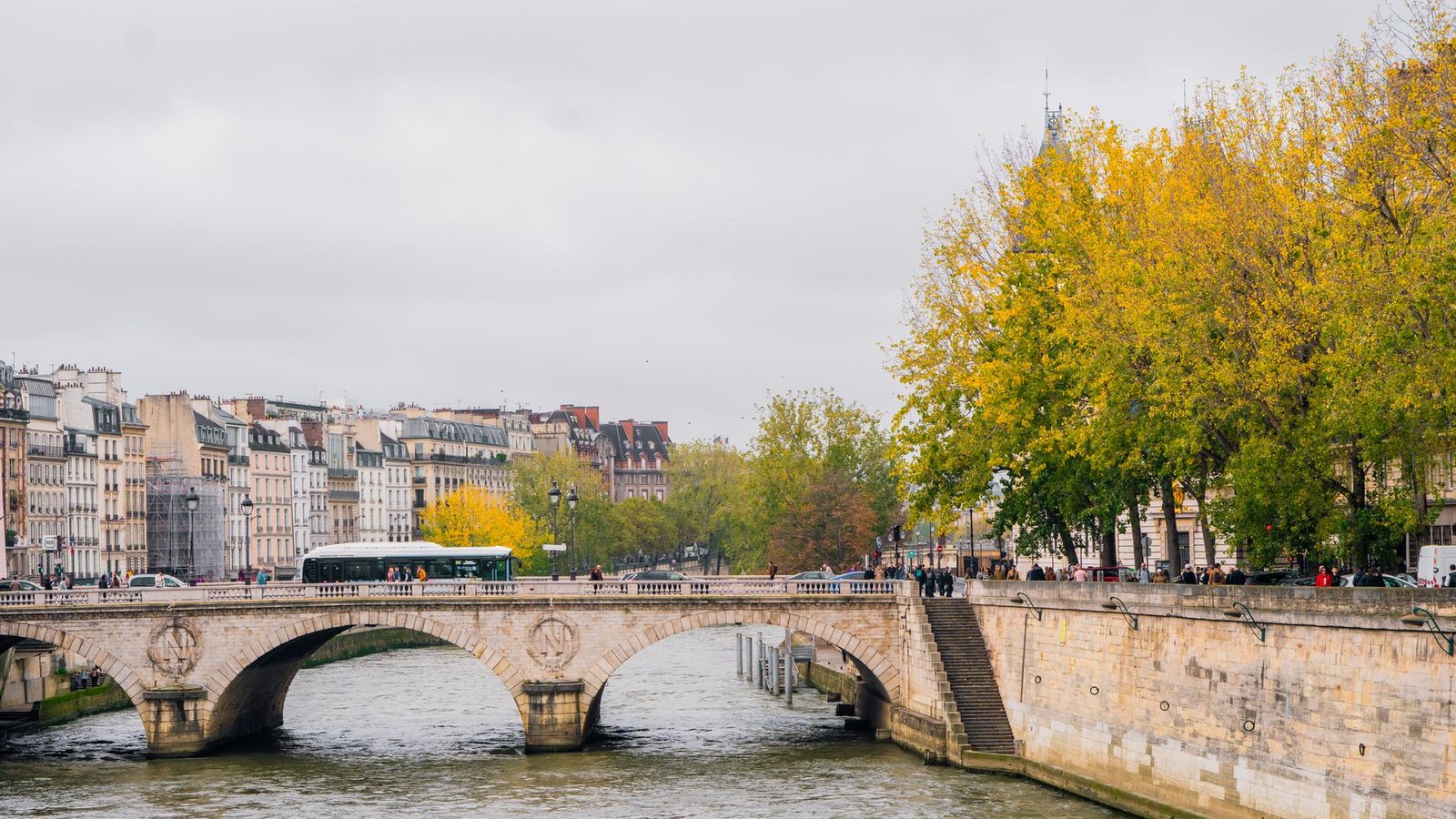
Some practical tips for making the most of the bridges:
Timing: the so-called “golden hour”—roughly one hour after sunrise and one hour before sunset—is when side lighting enhances textures and architectural details. For Pont Alexandre III, the sun setting in the west directly illuminates the statues. For Pont Neuf and Pont des Arts, the end of the day works well to capture warm light on the Louvre.
River level: the best perspectives of the bridges are often not on them, but on the banks of the Seine. The berges (riverbanks) of Paris have pedestrian stretches where you can get down to water level and photograph the bridge arches with their reflection. In summer, parts of the Seine banks feature urban beaches (Paris Plages) that add even more life to the scene.
Night: the bridge lighting turns on automatically at dusk. Pont Alexandre III, in particular, looks like a different structure at night—the lit lampposts and columns create a completely different atmosphere. If you use a camera on a tripod or a phone with night mode, the results are good even without professional equipment.
Combine with a boat ride: seeing the bridges from below, sailing along the Seine, is a completely different experience from photographing them from above. Traditional boat tours pass under all the bridges in the center, and the perspective of the arches seen from the water is stunning.
How to Plan a Walking Route of the Bridges
The concentration of bridges along the central stretch of the Seine—between the Eiffel Tower and Île de la Cité—allows you to create a 3 to 4-hour walking tour covering the main spots. Here’s a suggested sequence:
Start at Pont de Bir-Hakeim (metro line 6), enjoy the photos with the Eiffel Tower in the background, and walk along the Seine bank toward the center. In about 20 minutes, you’ll reach Pont Alexandre III—take your time here. Continue to Pont des Arts (another 20-minute walk) and then head down to Île de la Cité to Pont Neuf. The total route is about 4 km on flat ground, almost always with the river by your side.
If you prefer to do it in reverse, the metro ride back is easy: from Pont Neuf, take line 7 toward Champ de Mars or walk to Saint-Michel to catch lines 4 or 10.
Frequently Asked Questions About the Bridges of Paris
How many bridges does Paris have over the Seine?
There are 37 bridges crossing the Seine within Paris city limits, plus pedestrian-only walkways.
Do the love locks on Pont des Arts still exist?
No. In 2015, the city of Paris removed the approximately 45 tons of accumulated padlocks and replaced the railings with transparent glass panels.
What is the most beautiful bridge in Paris for photography?
It depends on what you’re after. For ornate architecture: Pont Alexandre III. For a composition with the Eiffel Tower: Pont de Bir-Hakeim. For a tranquil atmosphere: Pont Neuf or Pont Mirabeau.
Are the bridges of Paris wheelchair accessible?
Most major bridges have ramp access or a flat surface. The stairways down to the banks don’t always have ramps, but the bridges themselves are generally accessible.
Is it safe to walk across the bridges at night?
Yes, the main bridges are well-lit and busy at night, especially in summer. As with anywhere in Paris, it’s wise to stay aware of your surroundings.