The Louvre Museum is the largest and most visited museum in the world—and also one of the most intimidating for anyone who shows up without a plan. With over 35,000 works on display across 73,000 square meters of galleries, trying to “see the Louvre” without a game plan is a surefire way to leave exhausted, disoriented, and feeling like you didn’t really see anything at all.
The good news is that two well-planned hours are enough to see the museum’s most iconic works and walk away with a memorable experience. This itinerary shows you exactly what to see, in what order, and which entrance to use, so you can make the most of every minute without wasting time wandering the hallways.
Why 2 Hours Is Enough (If You Have a Plan)
Many visitors make the mistake of trying to see the entire Louvre in a single day. The inevitable result is what’s known as “museum fatigue”: after 3 to 4 hours, your brain simply stops processing the artwork, and everything starts to look the same. For most people, the most satisfying approach is to pick a handful of masterpieces and spend real time with each one, rather than speed-walking through hundreds of rooms without stopping.
With 2 hours well-spent, you can comfortably see 5 of the museum’s most important works, understand the context of each, and still have time for a strategic pause in the inner courtyard. This itinerary is designed to minimize walking between pieces and maximize quality time in front of each one.
Dica: Aproveite também para fazer estes passeios em Paris
Tour pelo exterior da catedral de Notre Dame + Ingresso da cripta . Duração: 2 horas
Disneyland Paris Duração: 3 horas ou mais
Passeio de barco pelo Sena. Duração: 1h
Ingresso do 3º andar da Torre Eiffel. Duração: 2 a 3 horas
Ingresso do Palácio de Versalhes. Duração: 2 a 3 horas
Veja mais passeio em Paris aqui.
Before You Enter: Choose the Right Entrance
The entrance you use to access the museum makes a significant difference in the time you spend before even seeing your first work of art. There are three main options:
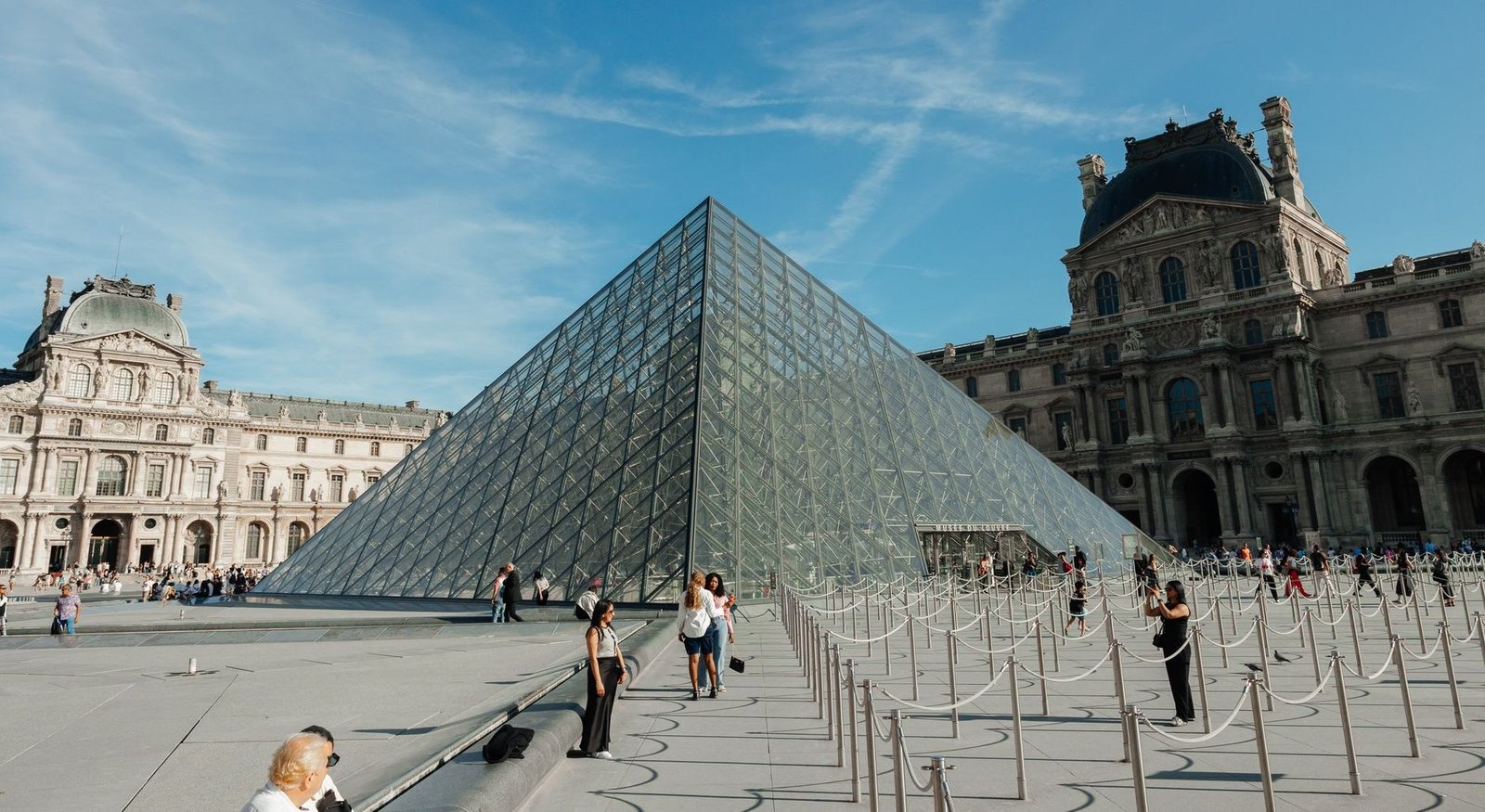
Glass Pyramid (Main Entrance)
The entrance through the Pyramid, in the center of the Cour Napoléon, is the most famous and also the busiest. During peak hours (between 10 a.m. and 2 p.m. on weekdays, and pretty much all day on weekends), the line can last 30 to 60 minutes even with a pre-purchased ticket. The advantage is its centrality—from the underground lobby, it’s easy to orient yourself and choose any wing of the museum. If you’re going during this time, arrive before 9 a.m. (the museum opens at 9 a.m.) or after 3 p.m.
Richelieu Entrance (Rue de Rivoli)
The entrance through the Passage Richelieu, accessible from Rue de Rivoli (next to the museum’s shopping mall), is significantly less crowded than the Pyramid and leads directly to the same underground lobby. For those with pre-purchased tickets, this is often the fastest option, especially during high season. The security line is usually much shorter than at the Pyramid during peak times.
Carrousel du Louvre Entrance
There’s also an entrance through the Carrousel du Louvre underground shopping mall, which connects to the museum. It’s less known among tourists and tends to have shorter lines, especially in the early morning hours. It’s worth checking if this entrance is operational on the date of your visit, as hours can vary.
Regardless of which entrance you choose, have your ticket already purchased and downloaded to your phone before you arrive. Buying at the box office on the day not only costs more but also wastes precious time from your 2-hour visit.
The 2-Hour Itinerary: The 5 Essential Works
After entering through the Pyramid lobby and orienting yourself with the map (available for free at the entrance), follow this itinerary in the order given—it’s designed to minimize the distance traveled between each piece.
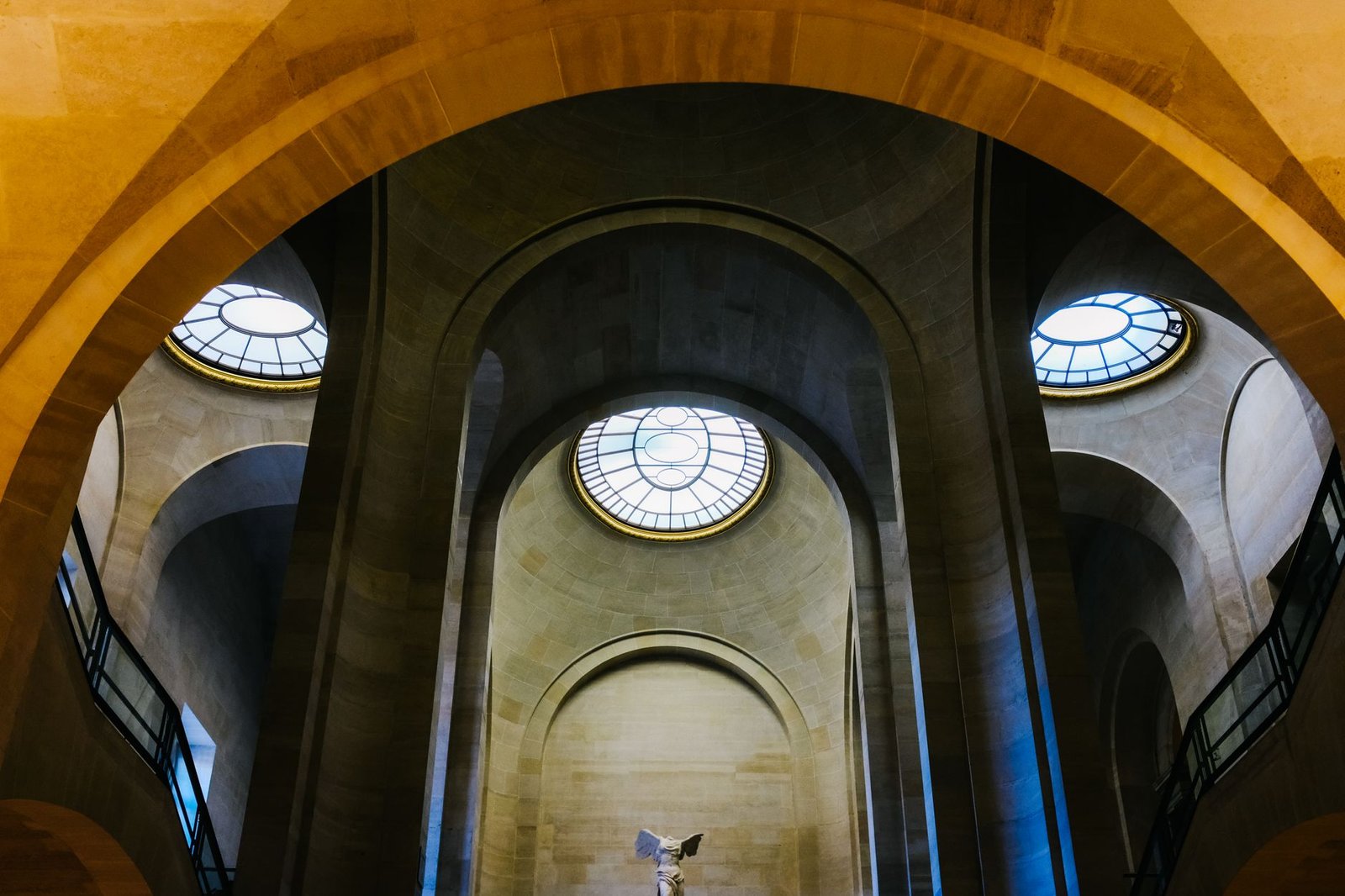
1. Winged Victory of Samothrace — Sully Wing / Daru Staircase (15 min)
The first stop is the Winged Victory of Samothrace, a Greek sculpture from the 2nd century BC depicting the goddess Nike in a triumphant pose, with her wings spread wide. Positioned at the top of the grand Daru Staircase, the statue is one of the most striking sights in the entire museum—you see it from afar, at the top of the steps, and it seems to float in the air. The work was found in fragments on the Greek island of Samothrace in 1863 and arrived at the Louvre incomplete—the head and arms were never found, which only adds to the mystery. Spend 15 minutes here: climb the steps, walk around the sculpture, and observe the details of the wing feathers and the fabric of the dress carved in marble.
2. Venus de Milo — Sully Wing, Room 16 (15 min)
From the Winged Victory, head down the stairs and walk to the Venus de Milo, located in Room 16 of the museum’s Greek wing—the walk takes less than 5 minutes. This white marble statue of the goddess Aphrodite, dating from around 100 BC, is perhaps the most famous sculpture in the world. Discovered in 1820 on the island of Milos (hence the name), it arrived at the Louvre without its arms—another iconic work marked by the mystery of what’s missing. The absence of arms is also what sparks the most fascinating debate among historians: what was Aphrodite holding? An apple, a shield, a mirror? Spending 15 minutes here allows you to walk around the sculpture and see the details of the draped fabric covering the lower part of the body.
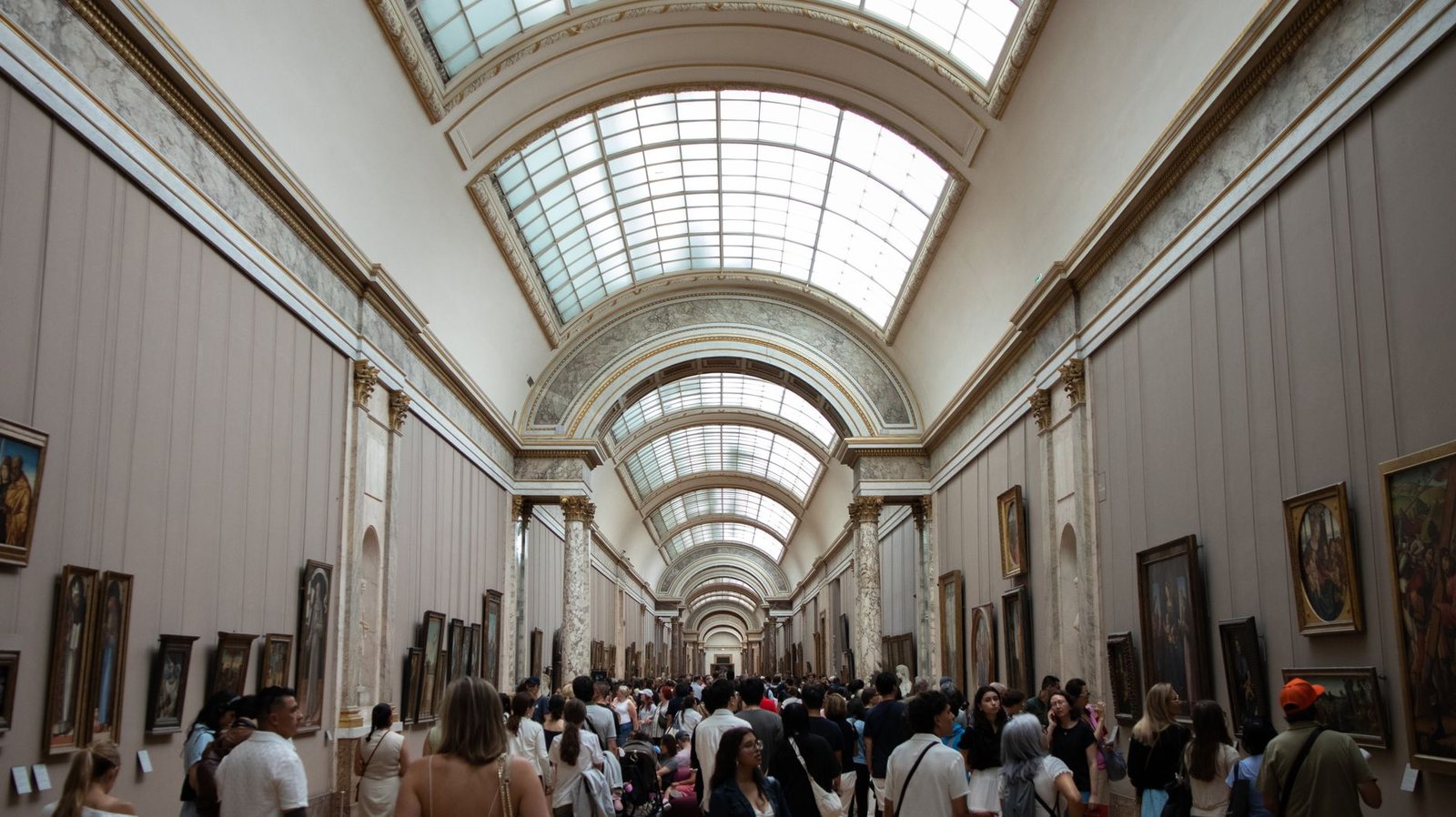
3. Grande Galerie (Galerie d’Apollon) — Denon Wing (15 min)
From the Greek sculpture area, walk to the Grande Galerie (also called the Denon Gallery or the Grande Galerie du Louvre), the magnificent hall of Italian paintings that stretches for hundreds of meters with Renaissance works. The ornate ceiling, gilded frames, and the infinite perspective of the room make this gallery an architectural spectacle in its own right. Works by Raphael, Leonardo da Vinci (not the Mona Lisa, but other pieces), Titian, and Caravaggio are spread across the walls. Even without stopping in detail at each work, walking through this gallery for 15 minutes gives you a powerful sense of the scale and richness of the museum’s Italian collection. This is also where you’ll get closer to the Mona Lisa room, the next stop.
4. Mona Lisa — Room 711, Denon Wing (20 min)
Room 711 in the Denon Wing houses the most famous work of art in the world. Leonardo da Vinci’s Mona Lisa sits on a specific wall, behind bulletproof glass, surrounded by a barrier that keeps visitors several meters away. Expect this: she’s smaller than most people imagine—the painting is only 77 x 53 cm, a far cry from the poster-sized reproductions everyone knows. There’s also always a crowd of visitors in front of her, even during quieter times.
The most important tip here: turn your back to the Mona Lisa and look at the opposite wall. There hangs The Wedding Feast at Cana by Paolo Veronese—a gigantic canvas measuring 9.9 x 6.6 meters that depicts the miracle of turning water into wine, with over 130 characters. This work was commissioned by the monastery of San Giorgio Maggiore in Venice, took 15 months to complete, and came to the Louvre via Napoleon. Almost no tourist stops to look at it—everyone has their back to it, snapping photos of the Mona Lisa. Spend at least 5 minutes observing The Wedding Feast at Cana. It deserves it.
5. Code of Hammurabi — Richelieu Wing, Room 227 (15 min)
To end the itinerary with something truly unique and not heavily contested by the crowds, walk to Room 227 in the Richelieu Wing to see the Code of Hammurabi—a 2.25-meter-tall black basalt stele engraved with 282 laws from Babylon, dating from around 1750 BC. It’s one of the oldest written legal documents in human history, and you can read it (translated) on the plaques next to it. Unlike the more famous works, this room is usually less crowded, allowing for a calm and contemplative observation. Seeing the cuneiform text carved into stone nearly 4,000 years ago up close is an experience that puts everything into perspective.
Time and Movement Tips
Following the order above (Winged Victory → Venus de Milo → Grande Galerie → Mona Lisa → Code of Hammurabi), the total walking time between the works is approximately 20-25 minutes. Adding the 15-20 minutes at each piece, you’ll total around 1h50 to 2h10—right on the planned limit.
To avoid getting lost, grab the free map at the entrance and identify the three main wings from the start: Sully (center-east, where the Greek and Egyptian sculptures are), Denon (south, where the Italian paintings and the Mona Lisa are), and Richelieu (north, where the Code of Hammurabi and Oriental antiquities are). Your itinerary starts in the Sully Wing, passes through Denon, and ends in Richelieu—an arc that covers all three wings without backtracking.
Best Times and Days for Fewer Crowds
The Louvre is open every day except Tuesdays. Normal opening hours are from 9 a.m. to 6 p.m., but on Wednesdays and Fridays, the museum stays open until 9:45 p.m.—these evening visits have fewer tourists and are highly recommended for those with flexible schedules.
The quietest times are the first hours of the morning (9 a.m. to 10:30 a.m.) and the last hours before closing (5:30 p.m. onwards, or 9 p.m. onwards on Wednesday and Friday nights). The 11 a.m. to 3 p.m. slot is the busiest of the week, especially in the Mona Lisa room. For a more relaxed visit, aim to arrive right at opening.
Weekends are always busier than weekdays. If you have flexibility, any day from Monday to Thursday is better than Saturday or Sunday. Rainy days also tend to have more visitors—everyone who canceled their outdoor plans decides to hit the museum.
Tickets: How Much and How to Buy
A Louvre ticket costs €22 for adult visitors from outside the European Union. Children and young people up to 17 enter for free, as do EU residents under 26. Entry is also free on the first Saturday of each month, from 6 p.m. to 9:45 p.m.—a great opportunity for a lower-cost visit, though this time slot is busier than usual.
Always buy your ticket online with a scheduled date and time on the official Louvre website (louvre.fr). Buying in advance guarantees access without facing the box office line, which during peak days can take longer than the visit itself. Tickets often sell out days or weeks in advance during high season (June to September and holidays), so plan ahead.
What Not to Do at the Louvre
Beyond the itinerary of what to do, there are some common mistakes that can ruin your 2-hour visit.
Don’t try to see everything. We’ve mentioned this, but it’s worth repeating. The Louvre has 403 rooms and 35,000 works on display. If you spent 30 seconds in front of each piece without breaks, it would take over 290 hours. Consciously choosing what to see is what separates a satisfying visit from an exhausting experience.
Don’t rely on printed maps alone. The museum is huge and the signage can be confusing. Download the official Louvre app before you go—it has an interactive map with real-time location that makes navigation much easier. The app is free and works in English.
Don’t go hungry. The café on the first floor is decent but pricey. Have a meal before you enter. Once inside, stopping for lunch at one of the museum’s restaurants is an expensive break that eats up a good chunk of your 2 hours.
Don’t underestimate the distances. What looks close on the map can be a 10-minute walk inside the museum. Follow the suggested route (Sully → Denon → Richelieu) to minimize backtracking.
For Those Who Want to Stay Longer
If you have 3 to 4 hours available, there are two natural extensions to this itinerary. The first is the Egyptian section in the Sully Wing—mummies, sarcophagi, and artifacts from Ancient Egypt that especially fascinate kids and teens. The second extension is the French Sculpture Gallery in the Richelieu Wing, a skylit space with monumental sculptures that few tourists know about.
For full-day visits (6 to 8 hours), consider adding the Greek and Roman antiquities in the Denon Wing (where the Venus de Milo is) in more detail, the Flemish and Dutch painting section (Vermeer, Rembrandt) in the Richelieu Wing, and the Napoleon III Apartments—a set of richly decorated rooms on the second floor of the Richelieu Wing that very few visitors discover.
No matter how much time you have, the secret to the Louvre is the same: choose less and appreciate more. Two well-planned hours leave a much more lasting impression than a whole day without focus. Enjoy your visit!