Most Paris itineraries don’t even come close to La Défense, and that makes sense: there’s nothing there like Notre-Dame or the Louvre. What you’ll find is something else entirely — a business district built starting in the late 1950s just a few miles from the Arc de Triomphe, with glass towers, one of Europe’s largest open-air art plazas, and a gigantic shopping center hidden inside a 1958 concrete structure.
Anyone who sets aside two or three hours to explore La Défense walks away with a very different image of Paris than the one on postcards — and understands how the historic city managed to keep its low skyline while still growing.

Dica: Aproveite também para fazer estes passeios em Paris
Tour pelo exterior da catedral de Notre Dame + Ingresso da cripta . Duração: 2 horas
Disneyland Paris Duração: 3 horas ou mais
Passeio de barco pelo Sena. Duração: 1h
Ingresso do 3º andar da Torre Eiffel. Duração: 2 a 3 horas
Ingresso do Palácio de Versalhes. Duração: 2 a 3 horas
Veja mais passeio em Paris aqui.
Where it is and how the district came to be
Despite the name suggesting a Parisian neighborhood, La Défense isn’t within the administrative limits of Paris. The district sprawls across three neighboring municipalities — Courbevoie, Puteaux, and Nanterre — all in the Hauts-de-Seine department, west of the capital.
The idea of building a business center there was born in the late 1950s, when the French government decided to concentrate vertical growth outside the historic center, preventing skyscrapers from competing for space with the Eiffel Tower or the Haussmannian zinc rooftops. The first building to come off the drawing board was the CNIT, inaugurated in 1958 by General de Gaulle himself and André Malraux, then Minister of Culture — its double-vaulted concrete structure still stands today and now functions as part of a complex of hotels, offices, and shops.
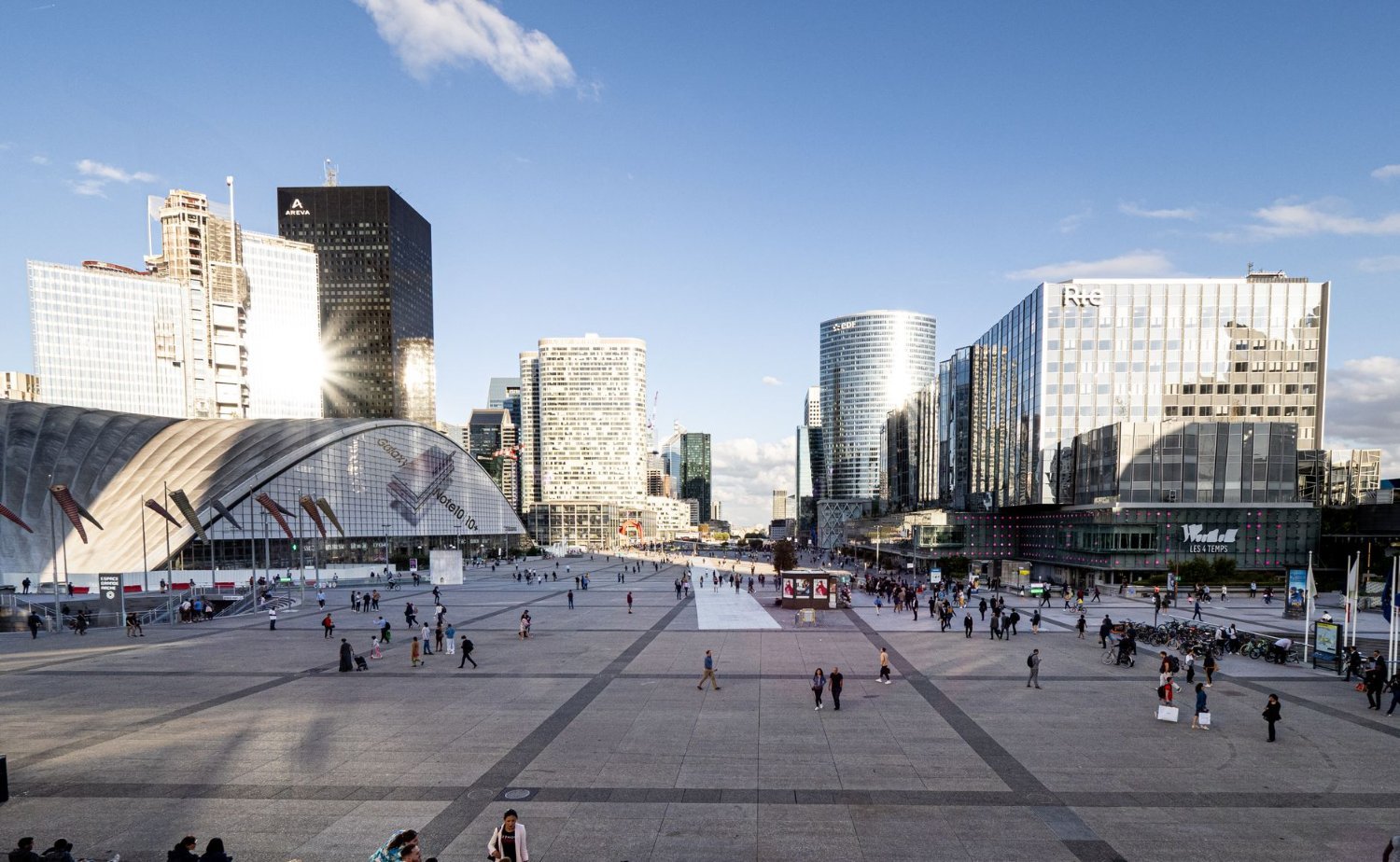
Today, La Défense is Europe’s largest business district, with 59 glass and steel towers, around 180,000 workers passing through every day, and a skyline that grows every few years with some new project.
It’s worth noting that the name “La Défense” has nothing to do with modern military matters: it comes from a bronze statue erected there in honor of the defense of Paris during the Franco-Prussian War of 1870-71, created by sculptor Louis-Ernest Barrias and inaugurated in 1883, long before any skyscraper existed in the area.
The Grande Arche: the district’s iconic monument
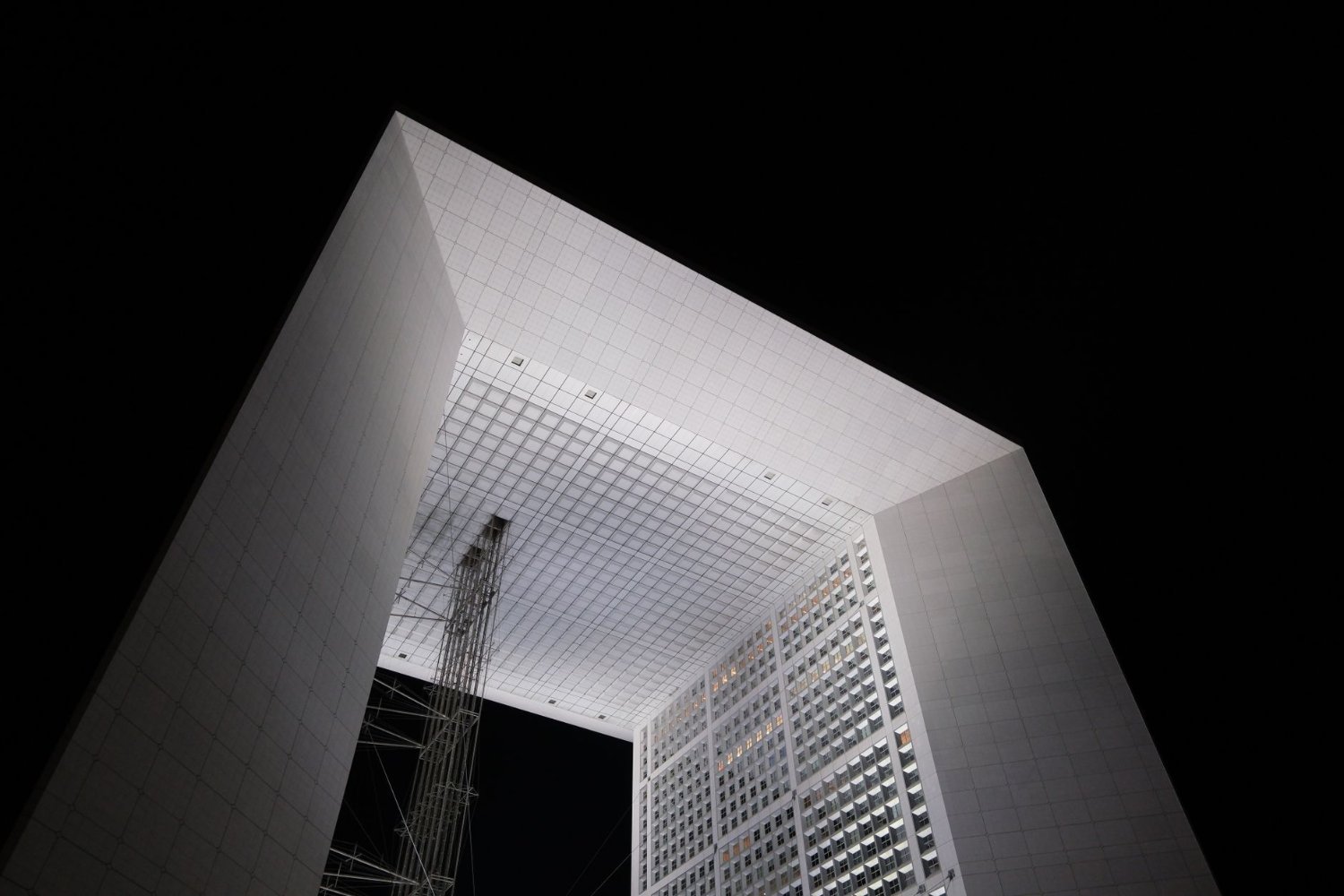
The postcard image of La Défense is the Grande Arche, a hollow cube of granite and glass about 110 meters high, designed by Danish architect Johan-Otto von Spreckelsen and inaugurated in 1989, on the bicentennial of the French Revolution. The scale is so massive that, according to descriptions from the time, Notre-Dame Cathedral could fit inside the arch’s central opening.
A direct heads-up, because this is the kind of info that changes over time and is worth confirming before planning your visit: the panoramic terrace that used to be at the top of the Grande Arche has been closed to the public since 2023, with no announced reopening date. This means that, for now, the experience is limited to the exterior view — which is still worth the stop, given the structure’s size, but don’t expect to go up like at other Paris viewpoints.
An open-air art museum on the esplanade
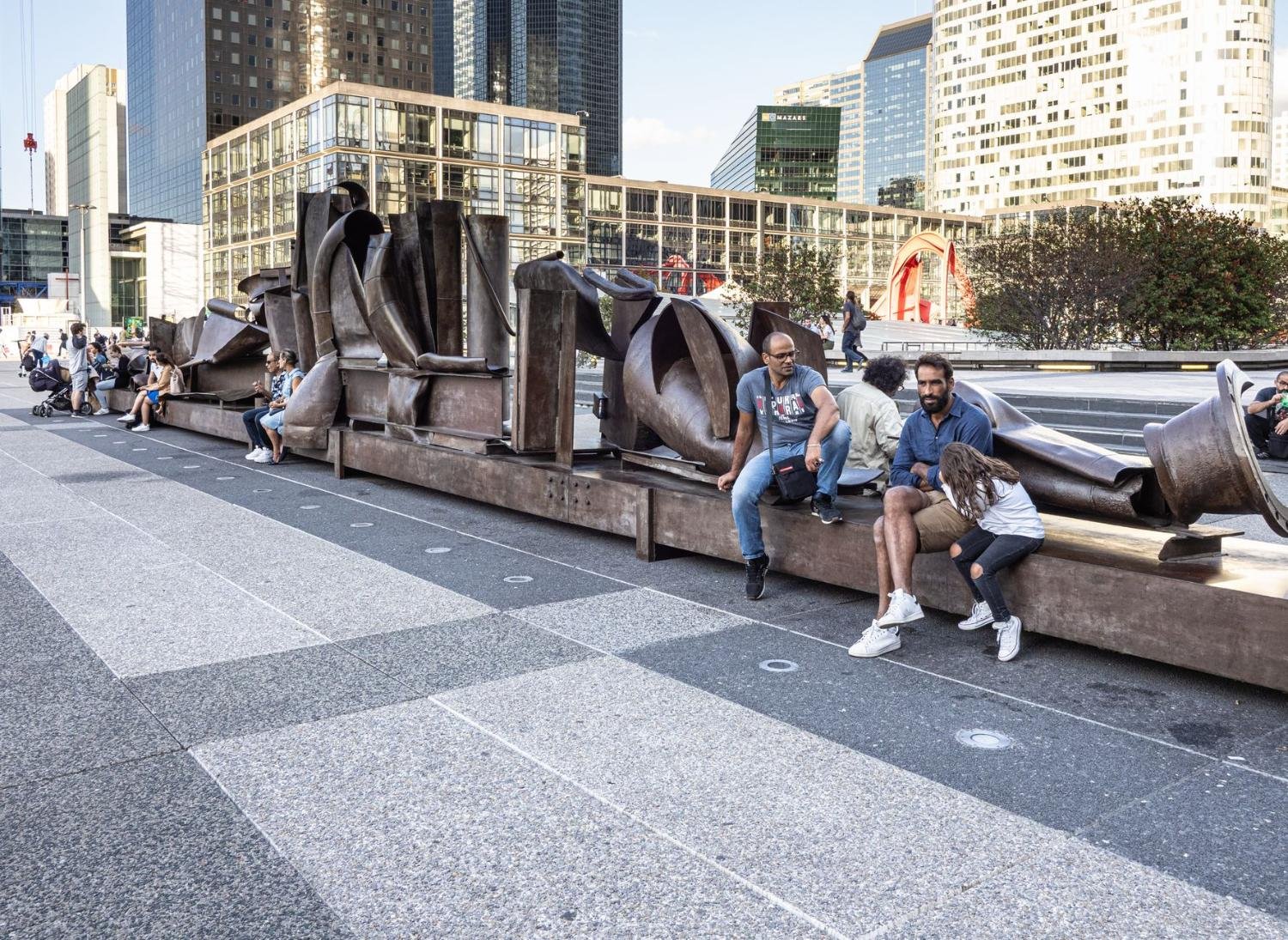
The part that surprises most people is the La Défense esplanade, a pedestrian axis over a kilometer long between the towers, dotted with nearly 60 monumental works of art — and access is free, 24 hours a day, no ticket required.
Three pieces usually catch the eye even of those with no particular interest in contemporary art. The “Araignée Rouge” (Red Spider) by Alexander Calder is a 15-meter-high, 75-ton steel structure. Nearby, “Les Personnages Fantastiques” by Joan Miró features two 12-meter resin figures with the vibrant colors typical of the Catalan artist. And “Le Pouce” by César Baldaccini is exactly what the name promises: a giant 12-meter, 18-ton thumb cast in bronze.
Walking from one end of the esplanade to the other, stopping to look at these pieces, is the best way to grasp the scale of the district without spending a dime — just your time.
CNIT and Westfield Les 4 Temps: shopping inside an architectural landmark
The aforementioned CNIT, from 1958, is now connected to the Les 4 Temps shopping center (opened in 1981 and renamed Westfield Les 4 Temps after being acquired by the Unibail-Westfield group). Together, the two complexes total about 230,000 m² of retail space — enough for the duo to be considered the largest covered commercial complex in Europe, receiving something like 50 million visits per year.
For anyone in Paris facing a rainy day, it’s an interesting alternative to downtown shops: less historic charm, but plenty of stores, a large food court, and the advantage of being just a few minutes by RER from the city center.
How to get to La Défense
Getting there is simple and quick from central Paris. Metro Line 1 has its terminal station at La Défense — Grande Arche, the same line that runs through Champs-Élysées and Châtelet. The RER A also stops at the station, as do the Transilien L and U trains, and the T2 tram. From Charles de Gaulle–Étoile station (Arc de Triomphe), the RER A takes about 5 to 10 minutes to reach La Défense.
Given its proximity to the center, it’s perfectly possible to include La Défense as an extra stop on a day that already has another commitment — it doesn’t require setting aside a whole day of your itinerary.
Is it worth visiting? How much time to set aside
For someone in Paris for just a few days who wants to prioritize the classic itinerary, La Défense isn’t a priority. But for a second or third visit to the city, or for those who love architecture, urban planning, and contrasts, it’s an outing that fits comfortably into a free morning or afternoon.
Two hours is enough to walk the entire esplanade, see the Grande Arche up close, and spend a few minutes at Westfield Les 4 Temps. Anyone wanting to have lunch there has over 150 restaurants to choose from, ranging from fast food to more elaborate bistros.
The historic axis linking the Louvre to the Grande Arche
There’s an urban planning detail that few tourists notice: the Grande Arche is aligned with Paris’s so-called “historic axis,” an almost straight line that passes through the Louvre Courtyard, the Tuileries Garden, Place de la Concorde, the Champs-Élysées, and the Arc de Triomphe, before reaching La Défense. Standing at the top of the Grande Arche’s steps, looking in the right direction, you can see the axis stretching as far as the eye can see — one of those rare confirmations that this over 800-year-old plan of Parisian urbanism actually works in practice.
Paris La Défense Arena: Europe’s largest indoor arena
Another point that puts La Défense on the map beyond business is the Paris La Défense Arena, inaugurated in 2017 in the municipality of Nanterre. It’s the largest indoor arena in Europe, with a capacity exceeding 30,000 seats for concerts and sporting events. During the Paris 2024 Olympics, the arena was hastily transformed: the stadium that normally hosts concerts and rugby games had a 50-meter Olympic swimming pool installed right on its floor, and it hosted swimming events and water polo finals, with a reduced capacity of around 17,000 spectators watching the competitions.
Outside of the Olympic period, the arena continues to host international music tours and major sporting events — it’s worth checking the schedule if your trip coincides with a big show.
Families with young children also tend to approve of the stop: the flat floor of the esplanade makes it easy to navigate with a stroller, the giant sculptures grab kids’ attention more than many museums, and Westfield Les 4 Temps solves any unexpected hunger or bathroom needs without having to walk far.
Practical tips
Avoid going on a Sunday expecting to find the district buzzing — since it’s essentially an office area, the weekday crowd drops significantly on weekends, even though the shops and esplanade remain open. If your interest is in seeing the district in full swing, with people leaving work and the cafes busy, go on a weekday, preferably in the late afternoon.
Wear comfortable shoes: the esplanade has a gentle slope throughout, and it can get quite windy between the towers, even on sunny days.
Frequently asked questions
Can you go to the top of the Grande Arche?
Not currently. The panoramic terrace has been closed to the public since 2023, with no reopening date announced. The visit is limited to the exterior view of the monument and the surrounding esplanade.
Is La Défense inside Paris?
No. Technically, the district is in the municipalities of Courbevoie, Puteaux, and Nanterre, in the Hauts-de-Seine department, outside the administrative boundary of the city of Paris — although it’s treated as part of the metropolitan region and is just minutes from the center.
Is there an entrance fee for the sculptures on the esplanade?
No. The esplanade and the roughly 60 works of art installed on it are freely accessible, 24 hours a day, with no ticket required.
How long does it take from central Paris to La Défense?
Via the RER A, departing from central stations like Châtelet–Les Halles or Charles de Gaulle–Étoile, the trip usually takes between 10 and 20 minutes, depending on the starting point.
Can you combine La Défense with a visit to the Arc de Triomphe on the same day?
Yes, and it’s a combination that makes geographic sense: both attractions are on the same historic axis and connected by a single RER line, with just a few minutes of travel between them.
La Défense doesn’t replace any of Paris’s must-see stops, but it works well as a counterpoint — a way to see, side-by-side with the city of stone and zinc, the Paris that decided to grow upward somewhere else. To round out your tour of the city’s “alternative” viewpoints, check out our guide to the Montparnasse Tower.