You’ve already climbed the Eiffel Tower, walked the Louvre until your feet ached, and snapped the obligatory photo in front of Notre-Dame. Going back to Paris for the second time only makes sense if the itinerary is different—and the city has entire neighborhoods that most first-timer guides don’t even mention.
A 3-day Paris itinerary without repeating the postcards combines Canal Saint-Martin, Parc des Buttes-Chaumont, Marché des Enfants Rouges, Bercy Village, and the Marais beyond Rue des Rosiers—five areas that are just a few minutes by metro from the tourist center but rarely make it into first-visit plans.
How to get around between neighborhoods
All the stops on this itinerary are connected by metro lines 2, 3, 5, and 11, with no need for the RER.
Dica: Aproveite também para fazer estes passeios em Paris
Tour pelo exterior da catedral de Notre Dame + Ingresso da cripta . Duração: 2 horas
Disneyland Paris Duração: 3 horas ou mais
Passeio de barco pelo Sena. Duração: 1h
Ingresso do 3º andar da Torre Eiffel. Duração: 2 a 3 horas
Ingresso do Palácio de Versalhes. Duração: 2 a 3 horas
Veja mais passeio em Paris aqui.
A weekly Navigo pass is worth it if you’ll be hopping between neighborhoods farther from the center over three straight days—the fare varies by zone, so double-check the current price directly on the Île-de-France Mobilités website before buying. If you’ve been to Paris before, you probably already know the metro system inside out, but it’s worth noting these neighborhoods sit on the eastern and northeastern edges of the network, which means slightly longer rides between stops—usually 15 to 25 minutes by metro, transfers included.
Best time to go and how long to plan
Spring (April to June) and early fall (September) offer the best balance of mild weather and fewer tourists in these off-the-beaten-path neighborhoods, since the July and August visitor surge tends to cluster around the classic landmarks. Set aside the full 3 days for this itinerary, with mornings free for unhurried walks and afternoons reserved for markets and parks.
Unlike the monument circuit, which often requires advance ticket bookings in high season, the neighborhoods on this itinerary have no defined peak hours and no need for reservations—the only exception is a Seine cruise, which is worth booking a day or two ahead on busy dates.
Day 1: Bohemian east, from Canal Saint-Martin to Belleville
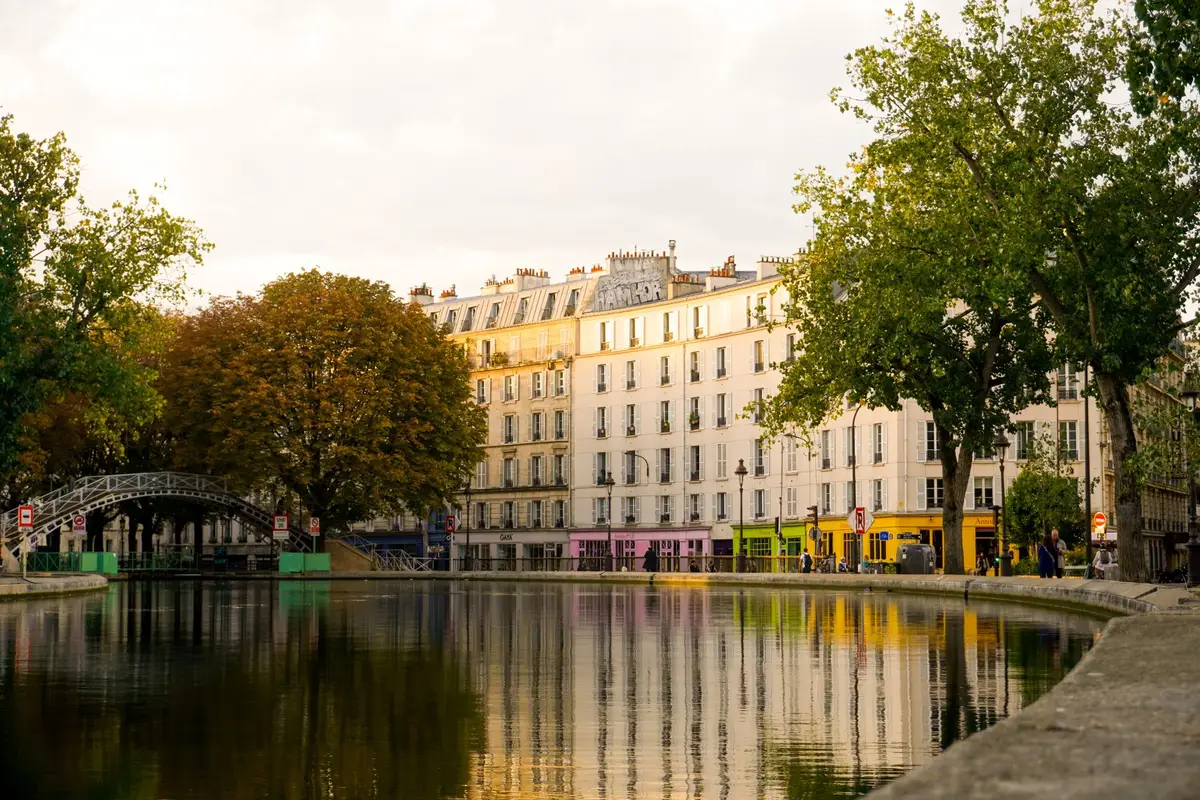
Start your morning strolling along Canal Saint-Martin, between the iron footbridges and the cafés that open early on Quai de Valmy—it’s the neighborhood where Amélie Poulain skips stones on the water, but also where Parisians picnic on the banks on sunny days. In the afternoon, head to the Belleville neighborhood, climbing to the park’s belvedere for a city view without paying for a viewpoint ticket.
It’s worth setting aside extra time to walk down from Belleville toward Rue de Belleville, where Vietnamese and Chinese restaurants share the street with street-art facades.
Day 2: Green spaces and markets, from Buttes-Chaumont to the hidden Marais
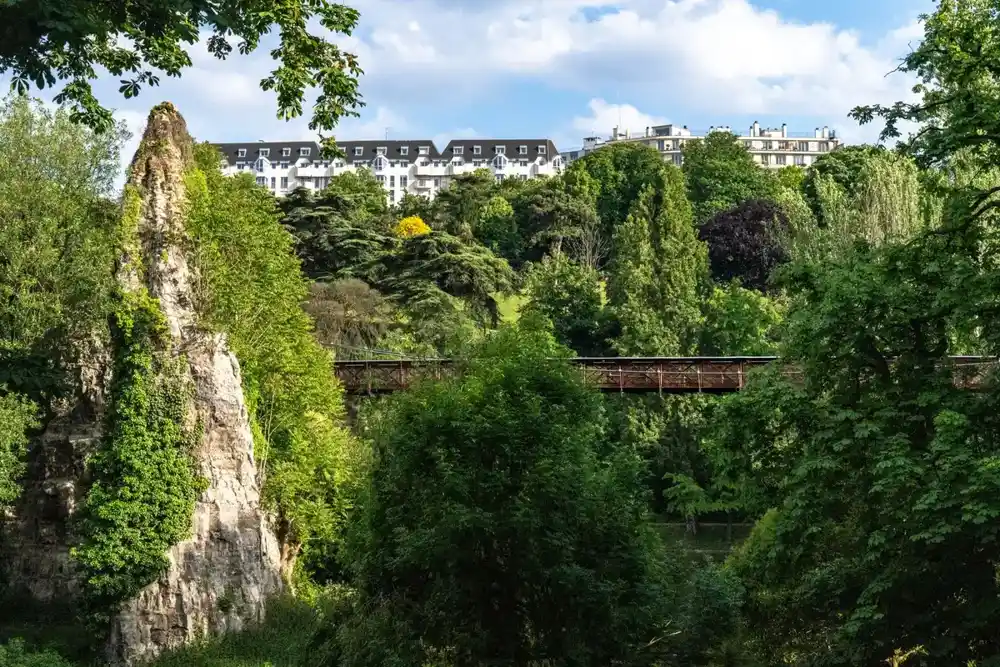
Parc des Buttes-Chaumont, in the 19th arrondissement, is a hilly park with a lake, an artificial waterfall, and a Greek temple perched on a cliff—one of the few places in Paris where you can sit on the grass without a “keep off” sign. In the morning, the park draws local joggers and families, almost no tourists.
The park was created in the 19th century on an old limestone quarry, which explains the steep slopes and the artificial cliff topped with the temple—an unusual landscaping choice for European standards of the time, and today one of the most photographed parks by Parisians, though still overlooked by first-time visitors.
Set aside at least an hour just to wander the park’s internal trails, which rise and fall in unexpected curves—a real contrast to the straight lines of the more formal gardens downtown, like the Tuileries.
In the afternoon, head down to the Marais and skip the crowded Rue des Rosiers—go straight to the Marché des Enfants Rouges, Paris’s oldest covered market, founded in 1615, with food stalls from around the world and communal tables. If you want historical context for the area, round it out with the Palais-Royal, one of the most elegant and least hyped detours in the center, with inner gardens and Buren’s famous striped columns.
Day 3: Water and architecture, from Bercy to Île Saint-Louis
Save the morning for Bercy Village, a former wine warehouse complex turned into a street of shops and restaurants, with the park next door perfect for a crowd-free break. In the afternoon, cross over to Île Saint-Louis, the island next to Notre-Dame that most tourists rush across on their way to the cathedral, never realizing it deserves a whole afternoon on its own.
Île Saint-Louis has no metro station of its own—the closest is Pont Marie on line 7, about a 5-minute walk from the bridge connecting the island to Notre-Dame.
Wrapping up the day with a Seine River cruise at sunset is a way to see the famous landmarks from a different angle, without having to go inside them all over again.
The boat route passes under historic bridges and reveals facades that don’t show up in photos taken from street level, shifting how you see places like the Louvre and the Eiffel Tower even if you’ve already been up close on your first visit.
Where to eat off the tourist trail
Marché des Enfants Rouges has Moroccan, Japanese, and Italian food stalls side by side, with market prices rather than tourist-restaurant markups. Near Canal Saint-Martin, the bistros on Rue de Marseille serve fixed lunch menus at prices well below what you’d pay near the Eiffel Tower or the Louvre.
At Bercy Village, the restaurants tucked into the old stone warehouses keep the historic vibe of the former wine complex alive, with options ranging from classic bistros to Asian cuisine — a solid choice for wrapping up day 3 without having to head back to the center for dinner.
It’s worth booking a table in advance on weekends, when Bercy Village’s restaurants draw both tourists and locals from the area, who treat the complex as their go-to nightlife spot.
Where to stay for this itinerary
Basing yourself in the 10th or 11th arrondissement, near the Canal Saint-Martin, puts you within a walk or a short metro ride of every stop on this itinerary, with nightly rates generally more affordable than in the historic center. According to the Office de Tourisme de Paris, these eastern neighborhoods have concentrated much of the city’s new hotel supply in recent years.
If you’d rather stay closer to the traditional center, the Marais also works as a home base, since it sits right between the Canal Saint-Martin, Bercy, and the Île Saint-Louis, cutting down travel time on two of the three days.
Practical tips
Pick up a weekly Navigo pass if you plan on using the metro a lot over the three days — it pays off compared to single tickets starting around your fourth or fifth ride. Many of these neighborhoods have fewer English signs; download an offline map and jot down street names before leaving the hotel.
Bring cash for the covered markets — some of the smaller stalls at the Marché des Enfants Rouges still don’t take cards for low amounts, a detail that’s easy to miss on itineraries focused only on the tourist center.
Set up a notes app or a map app with saved pins: since this itinerary crosses five different Paris neighborhoods in just three days, it’s easy to waste time hunting down exact addresses without having everything organized in advance.
Save your energy for plenty of walking: none of these neighborhoods has a metro stop right at the main attraction, and the real joy of this route is crossing residential streets along the way.
Frequently asked questions
Is it worth going back to Paris after already visiting the main tourist sights?
Yes. Paris has entire neighborhoods, like the Canal Saint-Martin, the Buttes-Chaumont, and Bercy Village, that rarely make it onto first-time itineraries and completely change the experience for anyone who already knows the central monuments.
How many days do you need for this off-the-beaten-path itinerary?
Three full days are enough to cover the Canal Saint-Martin, the Buttes-Chaumont, the Marché des Enfants Rouges, Bercy Village, and the Île Saint-Louis at a relaxed pace, including free time for markets and parks.
Do you need to pay admission for any of the places on this itinerary?
No. The Canal Saint-Martin, the Parc des Buttes-Chaumont, the Marché des Enfants Rouges, and Bercy Village are open public or commercial spaces with no entry fee — only the Seine river cruise has a ticket cost.
Are these neighborhoods safe to walk around?
Yes, they’re lively residential areas during the day; as with any big city, it’s worth keeping an eye on your belongings in high-traffic spots like markets and avoiding empty streets late at night.
Conclusion
Going back to Paris after a first visit is your chance to trade the Louvre line for real neighborhood life, without giving up the city that already won your heart the first time around. For more off-the-beaten-path Paris itineraries, keep exploring Torre Eiffel Brasil.