Exploring Paris in a wheelchair calls for an itinerary that matches the city’s pace: elevators can be out of service, the old metro rarely helps, and an uneven sidewalk can change the timing of every stretch. In two days, you can combine the Eiffel Tower, the Seine, the Louvre, and the Marais using the RER, buses, and an adapted taxi—without turning your trip into a marathon.
The safest approach is to use the RER for longer distances, buses to get around central Paris, and an adapted taxi reserved for any leg where a transfer or elevator fails. Don’t count on just any metro station: Line 14 is the only one that’s fully accessible end-to-end for wheelchairs.
Before you head out: what to confirm
The success of Paris in a wheelchair starts before you even board: map out each leg on the Île-de-France Mobilités planner with the wheelchair filter and check elevator status on the day. The RATP states that Paris buses are declared accessible but warns that a specific stop might not be; the same caution applies to RER stations.

Dica: Aproveite também para fazer estes passeios em Paris
Tour pelo exterior da catedral de Notre Dame + Ingresso da cripta . Duração: 2 horas
Disneyland Paris Duração: 3 horas ou mais
Passeio de barco pelo Sena. Duração: 1h
Ingresso do 3º andar da Torre Eiffel. Duração: 2 a 3 horas
Ingresso do Palácio de Versalhes. Duração: 2 a 3 horas
Veja mais passeio em Paris aqui.
Have three pieces of information written down: your chair’s width and weight, the type of transfer you need, and a phone number that works in France. For the RER, your route may require a ramp placed by an agent between the platform and the train; don’t cut it close on time. If your hotel is near an accessible RER station, that choice greatly reduces your reliance on taxis.
The RATP’s guide for wheelchair users is your daily reference: it brings together maps and guidance on buses, the RER, and Line 14. For trips outside Paris, also check the accessibility page on Île-de-France Mobilités, updated in May 2026.
Day 1: Eiffel Tower, Seine, and surroundings
On the first day, stick to the 7th and 16th arrondissements to avoid zigzagging: the Eiffel Tower in the morning, a relaxed lunch near the Champ-de-Mars, and the Seine in the late afternoon. This is the day when the bus usually beats the metro, since it lets you get off close to your destination while keeping the scenery in view.
Morning: Eiffel Tower with room for the elevator
Book your ticket with elevator access and pick the earliest available slot; the second floor is the realistic goal for wheelchair users, since the top isn’t reachable by elevator. You can get there by bus depending on your hotel’s address, or by adapted taxi to the esplanade. Read the access conditions on the Eiffel Tower’s official website beforehand, as security checks and elevators can alter your route.
To cut a line that adds nothing to the experience, it’s worth booking your Eiffel Tower ticket in advance. Leave a 30- to 45-minute buffer between arrival and your scheduled time: the accessible entrance and security screening deserve that breathing room.
After your visit, treat the Champ-de-Mars as a pause, not a mandatory shortcut: the paths are wide, but the ground and crowds vary. If your energy is running low, call the adapted taxi for your next stop instead of pushing through a second ride on public transit.
Afternoon: The Seine and a stop that doesn’t depend on stairs
In the late afternoon, head by bus or taxi to the Seine’s banks and prioritize a flat stretch, like the area around the Pont d’Iéna or the Trocadéro. The goal isn’t to cover the whole riverside—it’s to pick viewpoints, an accessible restroom, and a table to rest at before heading back.

A cruise can fit nicely into this moment, but confirm directly with the company about the dock, the ramp’s slope, door widths, and restrooms before you pay. Accessible doesn’t necessarily mean independent boarding at every tide; getting written confirmation avoids a surprise at the last minute.
Day 2: Louvre, Tuileries, and Marais
The second day works best along the Louvre–Tuileries–Marais axis: start early at the museum, take an outdoor break, and save the adapted taxi for the leg that cuts through the historic center. That way, you trade a string of cobblestones for short, controlled stretches.
Morning: The Louvre without trying to see everything
Set aside two or three hours at the Louvre Museum and pick one wing, not the whole building. The museum is huge, with elevators and accessible restrooms, but the experience improves when your plan starts out short: the Mona Lisa and one sculpture gallery, for example, are more honest goals than crossing every wing.
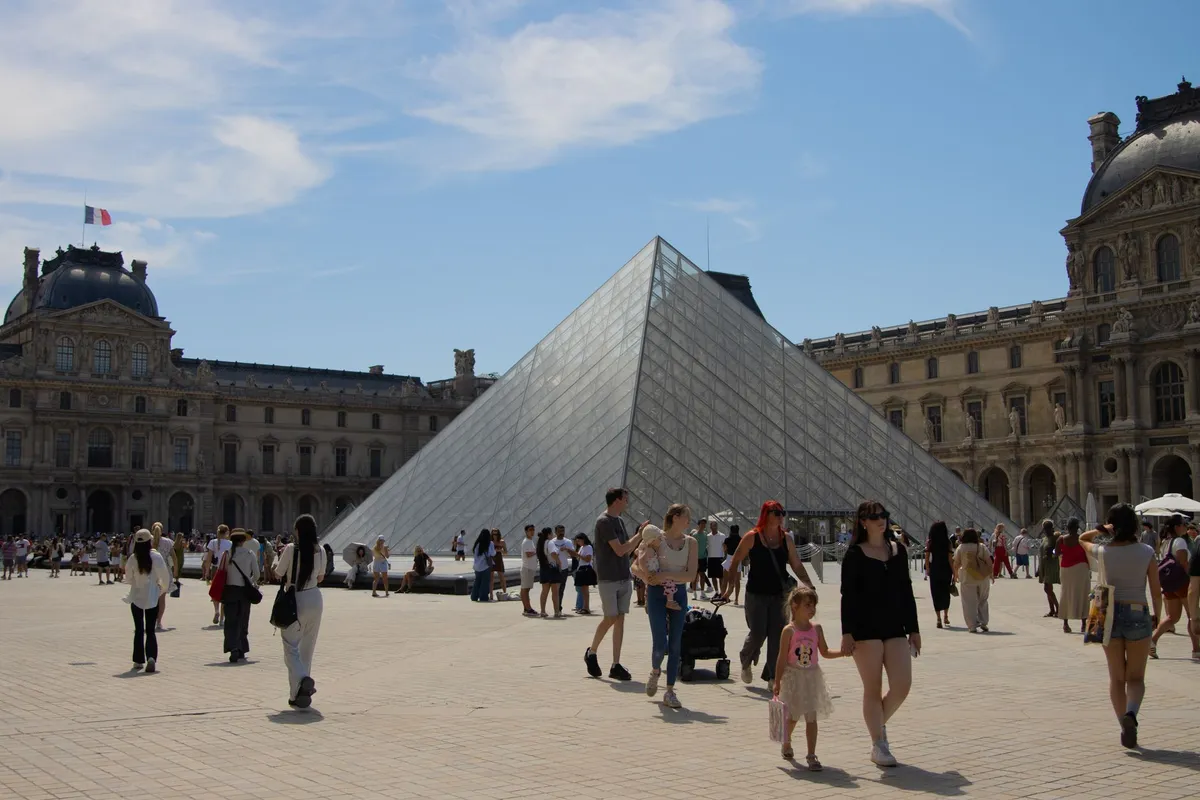
Before you go, compare this plan with our guide to visiting the Louvre Museum in Paris. It helps you decide on the wing and time slot; here, the difference is saving time for transfers and rest.
Afternoon: Tuileries, Marais, and a simple return
The Tuileries Garden is a great transition between indoors and the street: there are wide paths, benches, and easy exits to a bus stop. Afterward, do the Marais by adapted taxi, picking just one street or square at a time. The old sidewalks and stones demand more attention than the map suggests.
If you still have energy left, swap the Marais for a bus ride to the Opera area, avoiding the need to get off at old stations. Anyone wanting a lighter alternative can also check our guide to a Seine river cruise to move the river experience to this day.

The bus is the least glamorous link and, for that very reason, often the most useful: you can see the route, you don’t have to switch platforms, and you can get off early if an area is busier than expected.
How to use the RER, buses, and adapted taxis
The RER, buses, and accessible taxis each play a different role in getting around Paris in a wheelchair: the RER saves time on long routes, the bus handles the city center, and the taxi absorbs the gaps, the rain, and the fatigue. Switching between the three is more efficient than trying to prove that a single mode is enough.
On the RER, confirm the station, elevator, and assistance before you head out; boarding the train may depend on a ramp operated by an agent. On central routes, RER A and B are accessibility benchmarks, but your starting and ending points determine whether the option is actually a good one.
On buses, signal the driver and check the stop’s pictogram on the route map. Keep the route saved on your phone and have a backup stop a block or two away: even on an accessible line, the sidewalk or construction around the stop can prevent boarding.
For taxis, book ahead with a company that confirms a vehicle with a ramp or lift, wheelchair anchoring, and compatibility with your measurements. Give the exact address, time, wheelchair model, and whether you’ll be traveling seated in it; a regular taxi available on an app does not automatically equal an accessible taxi.
In practice, save the taxi for hotel–Eiffel Tower, Louvre–Marais, or a nighttime return. That’s where it buys you time and predictability. For travel references, also check out our guide on how to get to the Eiffel Tower, adapting the mode of transport to the day’s accessibility conditions.
Costs, Time, and Plan B
The two-day budget varies more with taxis and tickets than with buses. In July 2026, confirm fares on the official app before your trip, because tickets and rules change; don’t build your spreadsheet with outdated prices. Set aside a financial buffer for at least two accessible taxis, even if your plan is mostly public transit.
Have a Plan B for each day: if the RER elevator is out of service, swap the RER for a bus or taxi; if the Eiffel Tower is packed, use the Champ-de-Mars and Trocadéro and save the visit for another time; if it rains, extend your time at the Louvre and skip a walk. In Paris, cutting one attraction beats losing two hours trying to salvage a bad connection.
Before the FAQ, check the planner for the routes from your hotel to the Eiffel Tower and the Louvre in real time. The same route that seems simple at 10 a.m. may require a different combination in the late afternoon.
Frequently Asked Questions
Is Paris accessible for wheelchair users?
Paris is doable for wheelchair users when your itinerary prioritizes buses, the RER, Line 14, and accessible taxis. The city isn’t fully barrier-free: many metro stations and historic areas have limitations, so every trip needs a backup plan.
Can I use the RER in a wheelchair?
You can use the RER in a wheelchair at accessible stations, with elevators down to the platform. The RATP warns that boarding the train may require a ramp placed by an agent; confirm assistance and arrive early so you’re not depending on a tight connection.
Do all Paris buses accept wheelchairs?
Bus lines within Paris are declared accessible for wheelchair users, according to the RATP. Still, stop accessibility can vary due to construction, sidewalks, or local setup; check the route map and have a backup stop planned.
Is the Eiffel Tower accessible by wheelchair?
The Eiffel Tower allows wheelchair visits up to the second floor using elevators, subject to the monument’s operational conditions. The top is not accessible for wheelchairs. Book a ticket with elevator access and confirm safety procedures on the official site before your visit.
How do I request an accessible taxi in Paris?
To request an accessible taxi in Paris, book in advance with a company that confirms a ramp or lift, anchoring, and accepted dimensions. Provide the wheelchair model and measurements, number of passengers, time, and addresses; immediate availability on regular apps doesn’t guarantee an adapted vehicle.
Conclusion
Two days are enough to see a well-chosen Paris, not all of Paris. Use public transit when it’s predictable, save the accessible taxi for the sensitive spots, and leave room for a real break. At Torre Eiffel, you’ll find more practical guides to plan the next days in the city.