The Mona Lisa is the most famous work of art in the world—and for many Louvre visitors, it’s also the hardest to find and the most surprising to see in person. Tens of thousands of people arrive at the museum every day with the specific goal of seeing this small panel by Leonardo da Vinci. Many leave confused, disappointed, or without understanding what made that experience unique.
This guide maps out the exact route inside the Louvre to reach the Mona Lisa, explains what to expect when you see the artwork up close, and reveals what almost no tourist discovers: the massive masterpiece on the opposite wall that’s just as extraordinary—and far less crowded.
Where Is the Mona Lisa in the Louvre
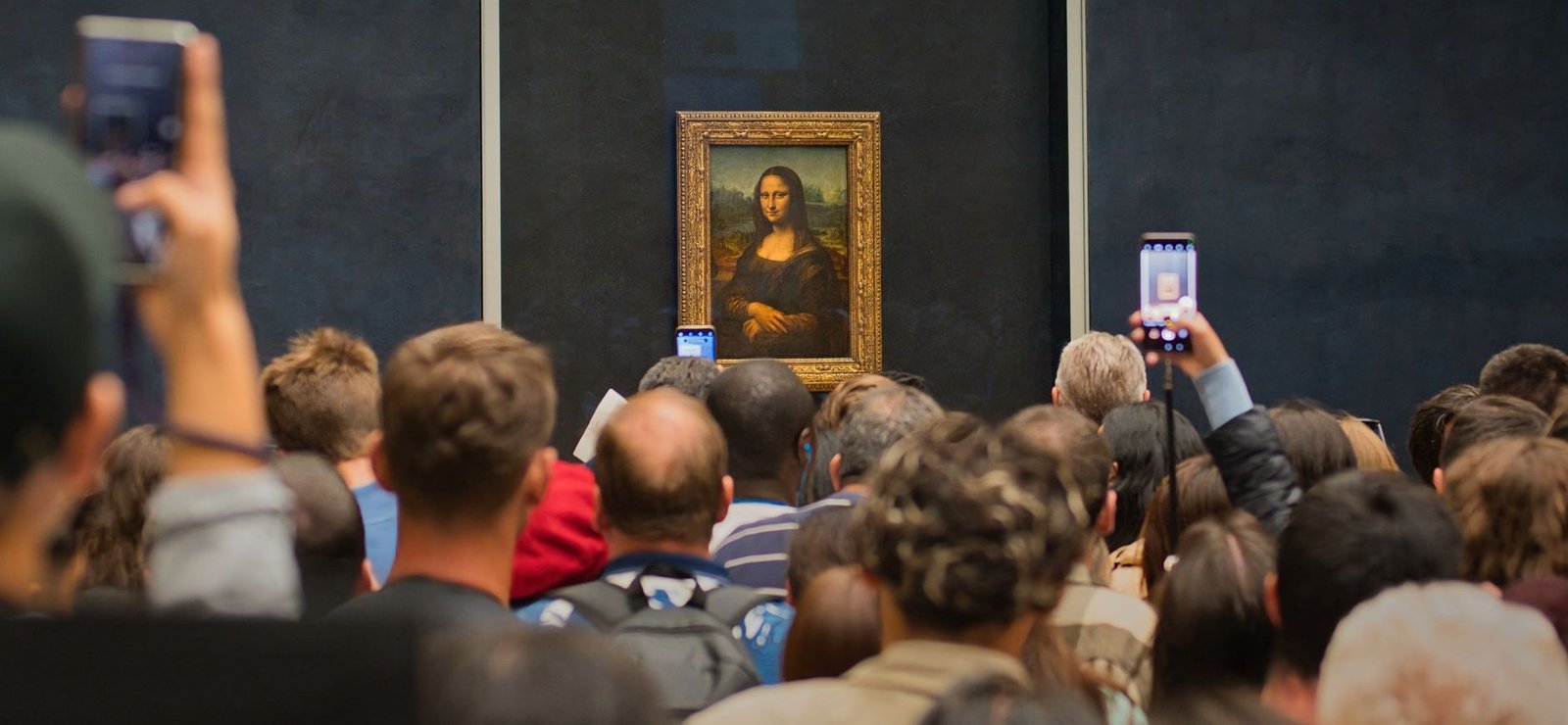
The Mona Lisa is in Room 711, also known as the Salle des États, located in the Denon Wing of the museum on the first floor (equivalent to the second floor in the American system). This is the most important piece of info: the Denon Wing is on the south side of the museum, accessible from the central lobby under the Pyramid. When you head down to the lobby through the main entrance, grab the free map available at the information desk and locate the “Denon Wing”—that’s where you’re headed.
On the official museum map, Room 711 isn’t hard to find, but the route to get there can be confusing if you don’t know exactly which way to go. There’s a commemorative plaque at the entrance to the Denon Wing pointing toward the Mona Lisa, and along the hallways, there are subtle arrows leading to the room. Following these arrows is the simplest method.
Dica: Aproveite também para fazer estes passeios em Paris
Tour pelo exterior da catedral de Notre Dame + Ingresso da cripta . Duração: 2 horas
Disneyland Paris Duração: 3 horas ou mais
Passeio de barco pelo Sena. Duração: 1h
Ingresso do 3º andar da Torre Eiffel. Duração: 2 a 3 horas
Ingresso do Palácio de Versalhes. Duração: 2 a 3 horas
Veja mais passeio em Paris aqui.
The Step-by-Step Route to Room 711
Following this route from the main entrance through the Glass Pyramid, you’ll reach the Mona Lisa in about 8 to 12 minutes of walking, without getting lost:
Step 1: Head down the stairs or take the elevator inside the Pyramid to the underground lobby (Hall Napoléon). Once there, you’ll see three wings marked: Denon (south), Sully (east), and Richelieu (north). Head toward the Denon Wing.
Step 2: Enter the Denon Wing and follow the main corridor toward the escalators or the grand staircase leading to the first floor. You’ll see large battle paintings on the walls—a good sign you’re on the right track.
Step 3: On the first floor of the Denon Wing, follow signs pointing to “Mona Lisa” / “Paintings” and step into the Grande Galerie—the long hallway of Italian Renaissance paintings. Walk through this gallery toward the eastern end.
Step 4: At the end of the Grande Galerie, turn left toward the Salle des États (Room 711). You’ll know you’ve arrived when you see a cluster of visitors visible from the room’s entrance, all pointing cameras in the same direction.
The total walk from the entrance is less than 500 meters in a relatively straight line, but the museum is big enough to disorient anyone without clear landmarks. Having the map in hand (or the Louvre app on your phone) is the travel insurance worth carrying.
What to Expect When You See the Mona Lisa Up Close
Here’s where the part nobody tells you before the visit begins: the experience of seeing the Mona Lisa in person is radically different from what most people imagine—both for better and for worse.
The Real Size of the Artwork
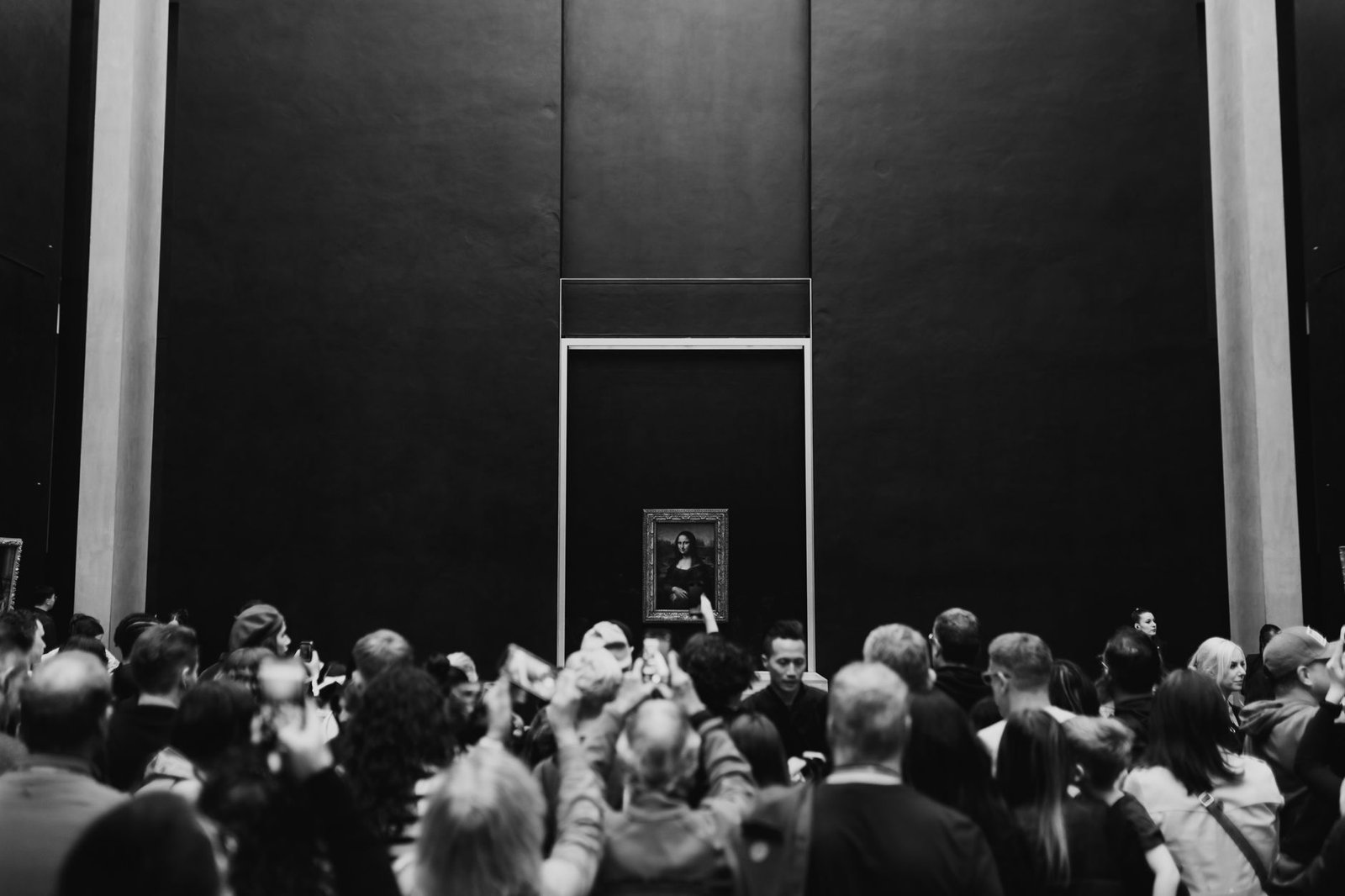
The Mona Lisa is only 77 x 53 centimeters. That’s roughly the size of an A1 sheet—about the size of a small poster in a teenager’s bedroom. When you walk into Room 711 and first see the artwork on the wall, surrounded by a massive wooden frame and behind bulletproof glass, the first reaction of practically every visitor is surprise: “It’s way smaller than I thought.”
This surprise over the size is so universal it’s become a cultural meme—there’s even a running joke about the Mona Lisa being the biggest disappointment in Paris. But the issue isn’t the size of the artwork; it’s the distance you’re forced to observe it from. A security barrier keeps visitors about 3 to 4 meters away from the canvas, which, combined with the small size and reflective glass, makes it hard to see the details that make the painting extraordinary: the ambiguous smile, the sfumato of light and shadow transitions, and the background landscape with pioneering aerial perspective.
The Crowd
On normal peak-season days, Room 711 has between 100 and 300 visitors at the same time, all trying to position themselves for the best photo. The noise, the body heat, and the impossibility of standing still in front of the artwork for more than a few seconds without someone pushing or stepping in front of you are unavoidable parts of the experience. During peak hours (10am-3pm), making it to the second or third row of people in front of the barrier is considered a good spot.
For the best possible experience with the artwork itself, go during the first 30 minutes after opening (9am-9:30am) or during the last hours before closing (especially on Wednesday and Friday nights, when the museum closes at 9:45pm). At these times, the room has far fewer people, and you can spend more time in front of the artwork and really observe it.
What Makes the Mona Lisa So Special
With all the difficulty of seeing it well and the inevitable disappointment over its size, the legitimate question arises: what makes the Mona Lisa the most famous artwork in the world? The answer is a mix of technical, historical, and accidental factors.
Technical Innovation: Sfumato
Leonardo da Vinci painted the Mona Lisa between 1503 and 1519, and the work represented pioneering technical advances in European painting. The most famous of these is sfumato—a technique of applying ultra-thin layers of translucent paint that creates smooth transitions between light and shadow, without defined outlines. The result is that “hazy” quality that gives the figure’s face an ambiguous expression, as if the smile changes depending on the viewing angle or the emotional state of the viewer. No painter before Leonardo had mastered sfumato on this scale.
The 1911 Theft and Global Fame
The Mona Lisa wasn’t the Louvre’s most famous artwork until 1911. That year, an Italian museum employee named Vincenzo Peruggia hid inside the Louvre, removed the artwork from the wall, hid it under his coat, and walked out through the delivery service. The theft wasn’t noticed until the next day. For over two years, the Mona Lisa disappeared—and the international coverage of the crime turned the artwork into a global icon. When Peruggia tried to sell the canvas in Florence in 1913 and was arrested, the return of the Mona Lisa to the Louvre was celebrated as a historic event. The global fame the painting has today is, in large part, a legacy of this theft.
The Indefinable Smile
For centuries, historians, scientists, and artists have tried to decipher the expression of Lisa Gherardini (the woman portrayed). The smile seems happy when you look at her eyes, and neutral when you look directly at her mouth. This effect has been studied by modern neuroscience: the peripheral area of vision processes shadows differently than central vision, and Leonardo’s sfumato was applied specifically to the transition zones of the face so that the expression varies depending on the viewer’s focal point. It’s a sophisticated and intentional optical illusion.
The Artwork Nobody Notices: The Wedding Feast at Cana
Here’s the most valuable secret of Room 711: turn your back on the Mona Lisa.
On the opposite wall, covering the entire length of the room, is The Wedding Feast at Cana (Les Noces de Cana), by Paolo Veronese—a canvas measuring 9.9 meters wide by 6.6 meters tall, with over 130 human figures depicting the miracle of turning water into wine described in the Gospel of John. It’s the largest painting on display at the Louvre, and one of the most elaborate and technically impressive in the entire museum.
Commissioned by the Benedictine monastery of San Giorgio Maggiore in Venice in 1562, the work took 15 months to complete by Veronese and his team. It arrived at the Louvre via Napoleon Bonaparte, who removed it from Venice during the Italian Campaigns of 1797. In The Wedding Feast at Cana, Veronese inserted self-portraits and portraits of his contemporaries in the role of the musicians at the center of the composition—including Titian, Bassano, and Tintoretto playing instruments. The figure of Christ is at the center of the table, but is one of the least imposing in the entire scene.
Why Nobody Looks at The Wedding Feast at Cana
The phenomenon is well-documented: in Room 711, practically 100% of visitors walk in, head toward the Mona Lisa, snap their photos, and leave—without ever turning around to look at the opposite wall. The combination of the Mona Lisa’s disproportionately greater fame with the room’s spatial layout (you enter and immediately see the Mona Lisa ahead) creates a blinders effect: what’s behind you simply ceases to exist.
This is one of the most fascinating ironies of cultural tourism: the second most important artwork in the room (which would, in any other museum in the world, be the centerpiece and most impressive piece of the collection) is completely ignored by the crowd that came specifically to this room. Spend 5 to 10 minutes observing The Wedding Feast at Cana in detail—look for the musicians at the center, identify Christ, and notice the perspective of the Venetian architecture in the background. It’s a completely different and much calmer experience than the battle for position in front of the Mona Lisa.
Other Must-See Artworks in the Nearby Rooms
Room 711 is set within a context of adjacent rooms with equally extraordinary artworks that most visitors pass by without stopping, because they’re busy going to or coming from the Mona Lisa.
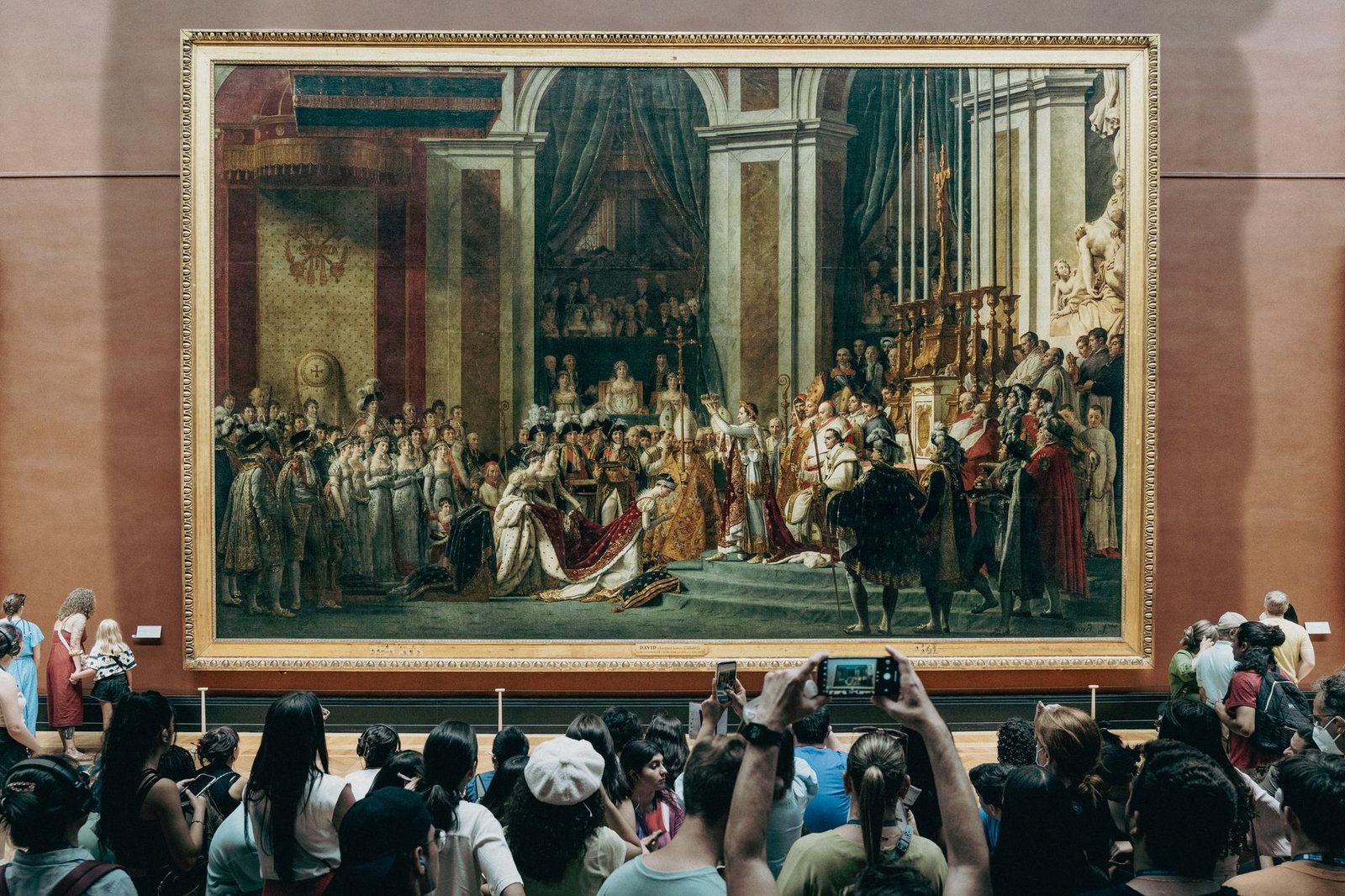
In Room 700, just before reaching the Mona Lisa, is The Holy Family by Raphael and several works by Titian—one of the greatest Venetian painters of the Renaissance. In Room 702, you’ll find The Coronation of Napoleon by Jacques-Louis David, a canvas measuring 9.8 x 6.2 meters that depicts Napoleon’s coronation ceremony at Notre-Dame in 1804. This work is almost as large as The Wedding Feast at Cana and equally impressive in scale and historical detail—and it has far fewer people in front of it than Room 711.
Tips for Photographing the Mona Lisa
Photographing the Mona Lisa in person is a challenge. The bulletproof glass reflects the ambient light, the artwork is small and far away, and the surrounding crowd constantly steps into the frame. Here are the most practical tips:
Use zoom: any modern smartphone has enough zoom to bring the image closer from the barrier. Use optical zoom (not digital) to maintain quality. A 3x to 5x zoom usually gives the right angle.
Avoid flash: flash reflects off the glass and completely ruins the photo. Turn it off before entering the room.
Wait for the moment: instead of trying to get the perfect shot in the middle of the crowd, position yourself patiently and wait for a natural gap where fewer people are in front of the artwork. These moments happen—especially when a large group moves at the same time.
Consider the photo without the artwork: many of the most creative photos of the Mona Lisa are those that show the crowd photographing the artwork, more than the artwork itself. The scene of dozens of smartphones raised toward a small painting behind glass is in itself a fascinating document of our time.
How Much Time to Spend in the Mona Lisa Room
Most visitors spend between 5 and 15 minutes in Room 711—enough time to snap the desired photos and observe the artwork from a distance. To make the most of the full experience, including The Wedding Feast at Cana and the artworks in the adjacent rooms, budget between 25 and 35 minutes for this area of the museum.
If you’re following the 2-hour Louvre itinerary, remember that Room 711 is just one of the stops. Don’t spend excessive time trying to get the perfect photo—the artwork is too small and the crowd too large for that to be realistic. Snap your photos, look at The Wedding Feast at Cana, and move on with your visit.
Frequently Asked Questions About the Mona Lisa at the Louvre
Do you need a special ticket to see the Mona Lisa? No. The standard Louvre ticket grants access to the entire permanent collection, including Room 711. There is no separate ticket or priority line for the Mona Lisa.
When is the room least crowded? During the first and last hours of operation. On Wednesday and Friday nights (when the museum closes at 9:45pm), the room after 8pm has fewer visitors than at any daytime hour.
Has the Mona Lisa ever been loaned to other museums? Rarely. The artwork has only traveled outside France twice since arriving at the Louvre—to the United States in 1963 and to Japan in 1974. The French government has classified the Mona Lisa as inalienable national heritage since 1909, which prevents its sale. It is a permanent resident of the Louvre.
Is the Mona Lisa going to be moved to a separate space? For years, there has been a proposal to move the artwork to a dedicated room with controlled access to improve the experience for those who want to observe it more carefully. Discussions continue without a definitive decision. In the meantime, it remains in Room 711.
The Mona Lisa is, above all, an experience—and like any good experience, what you take away from it depends on how willing you are to go beyond the surface layer of “I’ve seen it and photographed it.” With this guide, you’ll arrive prepared to see not only the most famous artwork in the world, but also what makes Room 711 a truly extraordinary place. Enjoy your visit!