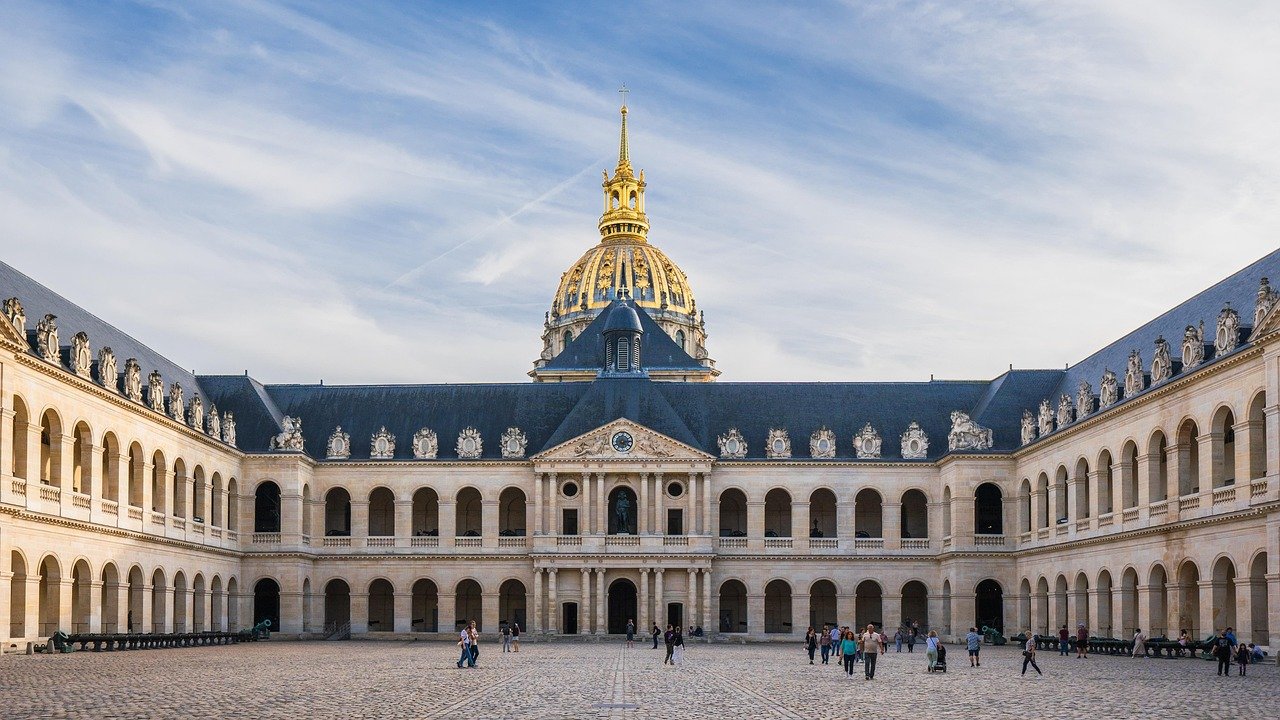
Les Invalides is Napoleon Bonaparte’s final resting place — and so much more. The complex in Paris’s 7th arrondissement houses the Dôme des Invalides with the Emperor’s sarcophagus, the world’s largest military museum, and a 500-meter esplanade that’s one of the city’s most beautiful green lungs. The €17 ticket grants access to everything: the Musée de l’Armée, the Dôme des Invalides, the Musée des Plans-Reliefs, and the Musée de l’Ordre de la Libération. The nearest metro station is Invalides (lines 8 and 13), less than a 5-minute walk from the main entrance. Plan for 2 to 3 hours — and leave via the esplanade on your way out to see the golden dome silhouetted against the Paris sky.
Dica: Aproveite também para fazer estes passeios em Paris
Tour pelo exterior da catedral de Notre Dame + Ingresso da cripta . Duração: 2 horas
Disneyland Paris Duração: 3 horas ou mais
Passeio de barco pelo Sena. Duração: 1h
Ingresso do 3º andar da Torre Eiffel. Duração: 2 a 3 horas
Ingresso do Palácio de Versalhes. Duração: 2 a 3 horas
Veja mais passeio em Paris aqui.
How to get to Les Invalides from central Paris

By metro, the most direct option is the Invalides station, served by lines 8 and 13. When you exit, the esplanade stretches out before you — the museum entrance is on the opposite side, on Avenue de Tourville. Another great option is Varenne station (line 13), about 400 meters from the main entrance and the closest to the complex’s south facade — bonus: on your way out, you’ll pass right by the Musée Rodin on Avenue de Varenne. La Tour-Maubourg station (line 8) is also about a 5-minute walk away. For up-to-date metro lines and schedules, check the RATP app.
On foot from other landmarks: from the Eiffel Tower, the walk through the Champ-de-Mars gardens and across the Pont d’Iéna takes about 20 minutes — and the route along the Quai d’Orsay with Seine views is worth every step. From the Musée d’Orsay, it’s about a 15-minute stroll across the Pont de la Concorde or the Pont de Solférino. From the Musée Rodin, it’s under 10 minutes on foot, making it easy to visit both on the same day.
Address: 129 Rue de Grenelle, 75007 Paris (main entrance). The esplanade entrance is on the north side, but the main access for ticket purchases is on Rue de Grenelle, at the south end of the complex.
Hours, price, and how much time to plan
Les Invalides is open daily from 10 AM to 6 PM, closing at 5 PM from October to March (check the official Musée de l’Armée website). It’s closed on January 1, May 1, and December 25. On the first Friday of each month, the museum stays open until 10 PM.
Tickets cost €17 per adult (June 2026) and grant access to every space in the complex: the Musée de l’Armée with its collections of armor, weapons, and military uniforms; the Dôme des Invalides with Napoleon’s tomb; the Musée des Plans-Reliefs with historic military scale models; and the Musée de l’Ordre de la Libération, dedicated to the French Resistance in World War II. Visitors under 18 get in free. Young people aged 18 to 25 who are citizens of the European Union also enjoy free entry.
Plan for 2 to 3 hours for a full visit. If you’re only interested in Napoleon’s tomb and the Napoleonic armor rooms, 1.5 hours might be enough. The complete military museum — with galleries spanning medieval wars through World War I — can easily fill an entire day for anyone with a deep interest in the subject.
The best time to enter is 10 AM, right at opening: the Dôme des Invalides with Napoleon’s tomb receives intense natural light in the early morning, casting golden reflections inside the dome. Avoid weekend afternoons in peak season, when the line for the Dôme gets long.
Napoleon’s tomb — and why it impresses even those who know nothing about him
You descend a few steps, cross the threshold of the Dôme des Invalides, and stop. The sarcophagus isn’t tucked into a discreet corner — it occupies the exact center of the nave, inside a circular sunken pit you view from above, from a balcony that rings the entire hall. The coffin is made of red porphyry from Finnish quartzite, polished until it gleams like metal, resting on a base of green granite from the Vosges. Around the pit, twelve marble statues representing Napoleon’s military victories form a permanent honor guard. On the dome’s ceiling, about 27 meters above, allegorical paintings gaze down over it all.
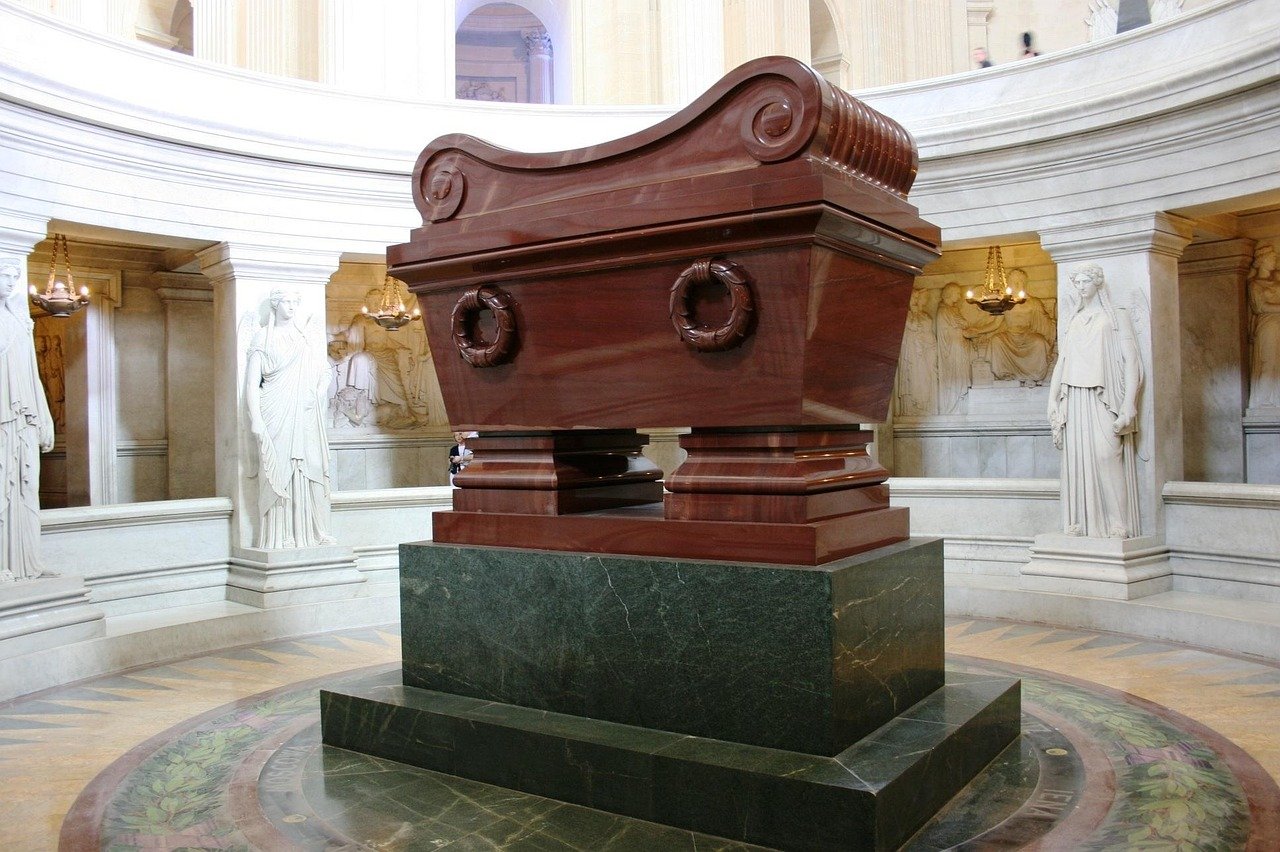
Napoleon died in 1821 on the island of Saint Helena, then a British colony in the South Atlantic. His ashes only returned to France in 1840, by order of King Louis-Philippe, after years of diplomatic negotiations. The current sarcophagus, designed by architect Louis Visconti, was inaugurated in 1861 under Napoleon III. Inside the red coffin lie six other concentric coffins made of different materials — a nesting doll of iron, ebony, oak, lead, mahogany, and bronze. Around the Dôme are also the tombs of other members of the imperial family, including Napoleon’s son, the King of Rome.
A tip: before entering the Dôme, visit the Church of Saint-Louis-des-Invalides — the “soldiers’ church” that precedes the Dôme. The enemy battle flags that once hung from the ceiling over the centuries have been removed (the originals are now in storage), but the space still feels austere and solemn in a way that’s completely different from the Dôme.
The Musée de l’Armée — the world’s largest military museum
Few tourists give this part of Les Invalides enough attention, even though it’s covered by the same €17 ticket. The museum spans several wings of the complex and covers over a thousand years of European military history. The medieval armor galleries from the 14th to 17th centuries are visually stunning — you walk among life-size knights on horseback in full armor, plus reconstructed battle scenes with equipped mannequins. If you’ve seen something similar at the Army Museum in Vienna or Edinburgh, here the scale is bigger.
The Napoleonic galleries, on the second floor, display the Emperor’s original uniforms (small, which always surprises people), swords, medals, and campaign maps. The World War I and II wing is the most extensive, with tanks, weapons, uniforms, photographs, and documents forming a dense narrative of both conflicts. The Musée des Plans-Reliefs, on the third floor, houses 1:600-scale military models of French cities and fortresses from the 17th century — some up to 10 meters long. These are rare objects that served as strategic planning tools for Louis XIV and Napoleon.
The esplanade and the exterior of Les Invalides
The Esplanade des Invalides is a 500-meter lawn stretching between the Seine’s bank and the complex’s north facade. Parisians use the space for picnics, reading, and jogging — and tourists who don’t enter the museum sometimes just sit on the grass with the golden dome behind them for a break in their itinerary. It’s also one of the best angles for photographing the dome without a crowd in front.
The main facade, facing south, stretches 196 meters. At the center of the north facade, overlooking the esplanade, stands the equestrian statue of Napoleon. The historic cannons lined up along the walls are originals — they were used in battles between the 17th and 19th centuries and today fire salutes on commemorative dates.
What to Pair on the Same Day
Since it sits in the 7th arrondissement, Les Invalides pairs perfectly with walkable neighbors: the Musée Rodin is right next door, and from there it’s a short stroll to the Seine riverbank and the Eiffel Tower. Across the river, you can tack on the Arc de Triomphe.

The Musée Rodin sits on Avenue de Varenne, less than a 10-minute walk from Les Invalides. The garden with The Thinker, The Kiss, and The Burghers of Calais deserves at least 45 minutes. If you’re hitting Les Invalides in the afternoon, add Rodin in the morning — or vice versa. The two complement each other beautifully as a 7th arrondissement itinerary.
The Eiffel Tower is about a 20-minute walk away through the Champ de Mars — a route that makes sense in either direction, since both monuments share the same neighborhood. For anyone wanting to better understand Napoleon’s figure and his legacy in the city, the article on Napoleon-related monuments and places in Paris shows how the Emperor shaped the French capital beyond Les Invalides.
The Musée d’Orsay is also about a 15-minute walk along the Seine — a high-culture combination for a full day, especially for those visiting Paris with a museum focus.
Where to Eat Nearby
The 7th arrondissement is one of Paris’s most elegant neighborhoods, and restaurant prices tend to reflect that. For a quick, reasonable meal, the brasseries and cafés on Rue Saint-Dominique, one block from Les Invalides, offer lunch menus between €14 and €20. The street also has excellent bakeries and fromageries for putting together a cheap picnic on the esplanade. For something more elaborate, the neighborhood has restaurants with fixed menus around €30 to €40 per person, serving classic French cuisine. Skip the bars directly in front of the museum entrance — inflated prices and inconsistent quality.
Practical Tips and Who It’s Worth It For
Buy your ticket online in advance, especially in July and August: the physical ticket office can have waits of 30 to 45 minutes. The official Musée de l’Armée website has an availability calendar by entry time.
Audioguide in English: available on-site for download to your own phone. The Dôme des Invalides guide, in particular, adds a ton of context about the construction of the sarcophagus and the return of Napoleon’s ashes.
Check special dates: during July 14th celebrations and on Napoleonic dates (like the anniversary of Austerlitz on December 2nd), the museum may have special events or altered hours.
Is it worth it? Yes, absolutely, for anyone with even a passing interest in European history. Traveling with kids over 8? They’ll find armor, cannons, and uniforms that grab their attention in a way schoolbooks never could. If you only knew Napoleon from afar, you’ll leave wanting to learn more. And if you’re going just for the tomb, you’ll be surprised by the size and quality of the rest of the complex. The most common mistake is not budgeting enough time — plan for at least 2.5 hours.
Frequently Asked Questions About Les Invalides
How much is the ticket for Les Invalides?
The adult ticket costs €17 (June 2026) and grants access to the entire complex: Musée de l’Armée, Dôme des Invalides with Napoleon’s tomb, Musée des Plans-Reliefs, and Musée de l’Ordre de la Libération. Visitors under 18 get in free. Young people aged 18–25 from the European Union also get free entry. Check current prices on the official website before your visit.
Which metro station serves Les Invalides?
The most convenient station is Invalides (lines 8 and 13), less than a 5-minute walk from the main entrance. Varenne station (line 13) is also close and handy if you’re coming from the Musée Rodin. La Tour-Maubourg station (line 8) is another option, about 5 minutes on foot.
How long does a visit to Les Invalides take?
Between 2 and 3 hours at a normal pace, including Napoleon’s tomb and the main rooms of the Musée de l’Armée. If you want to explore every wing of the military museum, it can take a full day. For those focusing only on the tomb and the Napoleonic rooms, 1.5 hours is enough.
Is Napoleon’s tomb inside Les Invalides?
Yes. Napoleon Bonaparte’s sarcophagus sits at the center of the Dôme des Invalides (the Invalides Dome Church), within the complex. Access is included in the €17 ticket. You enter through the Musée de l’Armée and reach the Dôme from inside the complex.
Is Les Invalides open every day?
Yes, the complex is open daily from 10 AM to 6 PM (5 PM from October to March). It closes only on January 1st, May 1st, and December 25th. On the first Friday of each month, it stays open until 10 PM. Check for any changes on the official Musée de l’Armée website.
To keep exploring the same stretch of the 7th arrondissement, also check out Musée Rodin in Paris: tickets, hours, and what to see.
Conclusion
Les Invalides is the kind of visit that delivers more than it promises. You go for Napoleon’s tomb and discover one of Europe’s most complete museums; you go for military history and leave with a fresh perspective on how France built its identity over the last three centuries. Arrive early, start at the Dôme while the light is still low, and leave enough time for at least the medieval armor halls and the Napoleonic rooms. The esplanade on your way out, with the late-afternoon sun gilding the dome, is the kind of scene that stays with you.