Taking your kids to see the Eiffel Tower is one of the most special moments a family can experience in Paris. The problem is that most parents arrive without knowing what to expect: massive lines, high floors, tired kids, and tickets that require planning. With the right information, though, the visit turns into a memorable adventure for the whole family.
In this complete guide, you’ll find everything you need to know about visiting the Eiffel Tower with kids: at what age it’s worth going up, how much it costs (little kids get in free), how to skip the lines with babies and toddlers, which floors to visit, and how much time to set aside for the experience.
Is It Worth Taking Kids to the Eiffel Tower?
The short answer is yes—but with planning. The Eiffel Tower is one of the most impressive structures in the world and fascinates kids of practically all ages. Babies and very young children (up to 2-3 years old) are amazed by the lights, the sounds of the city, and the sheer scale of the monument, even if they don’t fully understand what they’re seeing. School-age kids love the technical and historical experience, especially when you tell them how the tower was built in just two years for the 1889 World’s Fair.
The biggest challenge isn’t the tower itself, but the logistics around it: long lines, peak hours, and the natural fatigue of a child after a full day of sightseeing. With good planning, these obstacles are perfectly manageable.
Dica: Aproveite também para fazer estes passeios em Paris
Tour pelo exterior da catedral de Notre Dame + Ingresso da cripta . Duração: 2 horas
Disneyland Paris Duração: 3 horas ou mais
Passeio de barco pelo Sena. Duração: 1h
Ingresso do 3º andar da Torre Eiffel. Duração: 2 a 3 horas
Ingresso do Palácio de Versalhes. Duração: 2 a 3 horas
Veja mais passeio em Paris aqui.
Prices and Free Admission for Kids
One of the biggest draws for families is that the youngest kids get into the Eiffel Tower for free. Check out the current pricing policy by age group:
Children 0 to 3 years old: completely free entry to all floors, whether by stairs or elevator. You don’t even need to get a ticket for them.
Children 4 to 11 years old: pay a reduced fare. The price varies depending on how you go up (stairs or elevator) and which floor you go to. For the elevator to the second floor, the child fare is significantly lower than the adult one. The discount also applies for the top.
Youth 12 to 24 years old: some ticket options have an intermediate fare. It’s worth checking the tower’s official website before buying to get the most up-to-date prices.
Adults 25 and older: pay the full price, which varies depending on the access option chosen.
At What Age Does a Visit Make Sense?
This is the question parents ask most, and the answer depends on what you expect from the experience. Here’s a guide by age group:
Babies (0-18 months)
Babies can visit the tower with no practical issues—they get in free and there’s no age restriction for the visit. What changes is the experience: very young babies won’t remember the visit, but their parents will. If the logistics are smooth (well-rested baby, feeding schedule on track), it might be worth including a quick visit to the first floor. The structure has elevators and space to maneuver a stroller, though the lines require patience.
Toddlers (2 to 4 years old)
At this age, kids already interact with their surroundings and are impressed by the tower’s scale. The best part of the visit usually happens on the first floor, where there are interactive panels and the view is already impressive enough. Going up to the second floor can be tiring for kids this age, and the top is not recommended—the height and limited space can be scary. Bring snacks, a toy, and have a plan B in case your child doesn’t cooperate in the lines.
Kids (5 to 9 years old)
This is probably the best age to visit the Eiffel Tower with kids. They already have the patience to wait in line (especially if you have timed-entry tickets), are interested in the historical and technical aspects of the construction, and are amazed by the view. Going up to the second floor is highly recommended—the panoramic view of Paris from 115 meters (377 feet) up is transformative for kids this age. With energy and curiosity, the entire visit to the second floor takes families an average of 1.5 to 2 hours.
Tweens and Teens (10+ years old)
From age 10, kids can fully enjoy the experience, including the top (276 meters / 905 feet high). The visit to the third floor can be overwhelming in the best possible way—with visibility up to 70 km (43 miles) on a clear day, the glass observation deck, and the feeling of being at the highest point in Paris are unforgettable. Teens usually want to capture everything in photos and on social media, so get ready for a longer visit.
How to Buy Tickets with Kids
Buying tickets online in advance is absolutely essential when traveling with kids. Waiting in the on-site ticket line, which can take 2 to 3 hours during peak season, is a very stressful scenario with young children. By buying online, you choose a specific entry time and skip the ticket counter line—there’s still a short line for ticket scanning, but it’s incomparably faster.
When buying on the official website, you’ll select the number of adults and children by age group. For children under 4, entry is free and you don’t need to add a ticket for them—just show the attendant that the child is with you.
An important tip: buy your tickets at least 2 to 3 weeks in advance during high season (June to August and European holidays). The most convenient times for families—late morning and early afternoon—sell out first.
Strategies to Skip the Lines with Kids
Even with pre-purchased tickets, there’s an access line that can take 20 to 40 minutes. With kids, here are the most effective strategies:
Arrive exactly at your ticket time: timed-entry tickets have an entry window. Arriving too early won’t help—you’ll just wait outside. Arriving on time means getting in faster.
Go for the earliest time slots: entry slots between 9:00 AM and 10:30 AM have shorter lines than midday ones. With kids, waking up earlier and arriving at the tower right when it opens is one of the best strategies.
Bring snacks and water: hungry kids get cranky in lines. A backpack with cookies, fruit, and water makes the wait manageable. Note that there aren’t many cheap food options inside the tower—the snack bar on the second floor exists, but it’s expensive.
Entertainment for the line: a tablet or phone with downloaded content (videos or offline games) is your best ally. Also, using line time to tell kids the story of the tower works great—there’s a simplified and fascinating version: “the tower was built in 2 years, 2 months, and 5 days by over 300 workers, and it almost got torn down!”
Avoid weekends and holidays: if you have flexibility, weekday visits have significantly shorter lines. Saturday and Sunday during high season are the worst days for families with young kids.
What’s Interactive for Kids at the Eiffel Tower
The Eiffel Tower has evolved a lot to become more accessible and interesting for visitors of all ages, including kids. Here are the highlights that delight the little ones the most:
First Floor—The Most Family-Friendly
The first floor (57 meters / 187 feet high) is the most recommended for families with young kids. Besides the already impressive view of Paris, the floor has glass floors that let you see straight down—kids love it and are simultaneously scared and excited. There’s also a permanent exhibition about the tower’s history and construction, with informative panels that capture the attention of school-age kids.
The restaurant and snack bar area on the first floor has more affordable options than the second. On the outdoor space, kids can observe Paris from 57 meters up and spot other landmarks on the horizon—the Arc de Triomphe, Sacré-Cœur, and the Louvre are visible on clear days.
Second Floor—Panoramic View
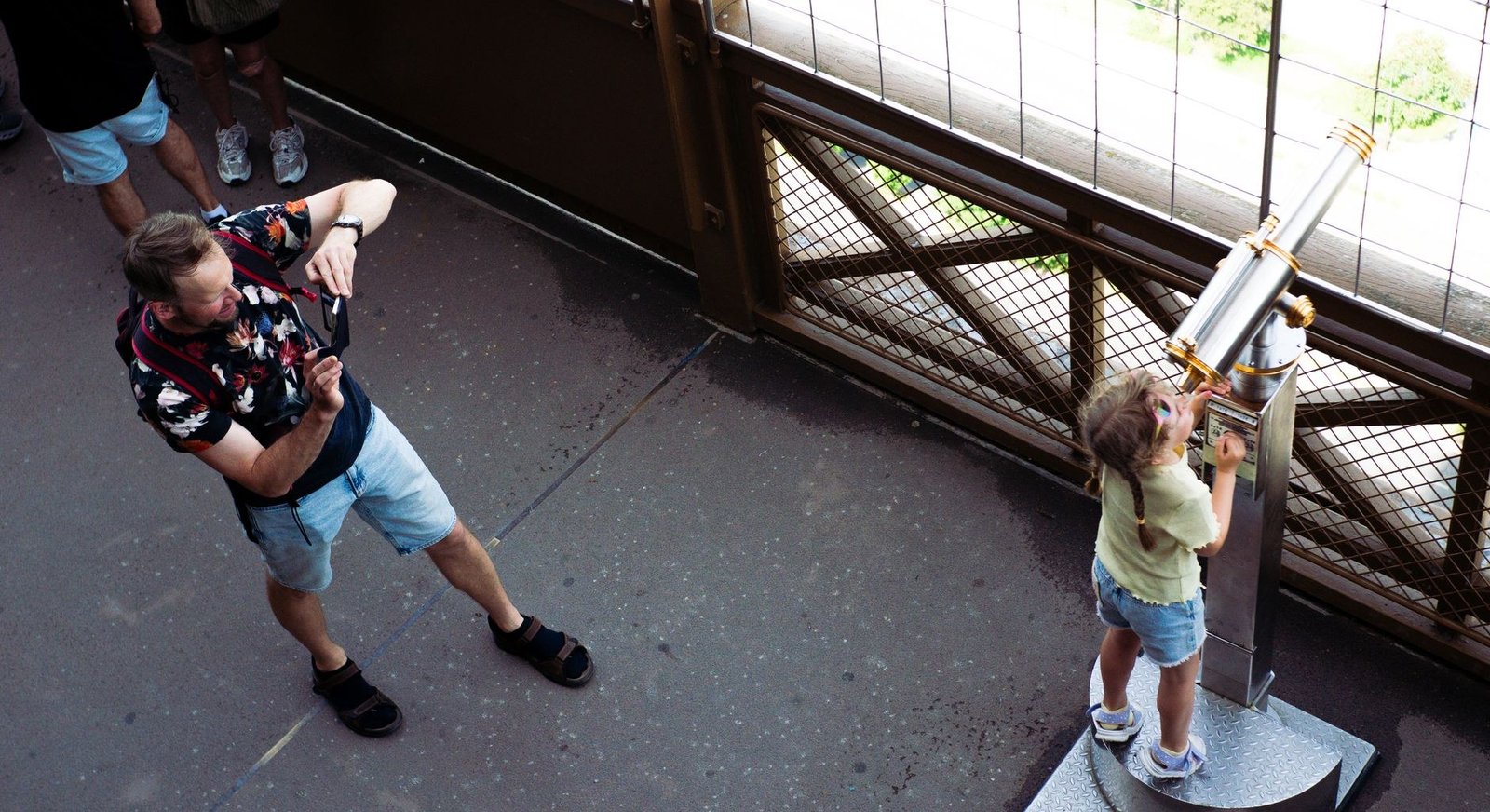
At 115 meters (377 feet) high, the second floor offers the best value for families. The view is significantly more impressive than the first floor, and the available telescopes are a big draw for kids—putting in a coin, pointing at the city, and discovering different spots in Paris is an activity that can last 20 minutes. The outdoor area on this floor is wider and airier, giving kids who need to move around more freedom.
The Top—For Older Kids
The third floor, at 276 meters (905 feet), is reserved for older kids and teens who can handle the height well. Access is more restricted in space, and on windy days, the tower can sway slightly (which is normal and safe, but can scare younger kids). Gustave Eiffel’s reconstructed office on this floor, with wax figures of Eiffel himself and Thomas Edison, is one of the tower’s most unique attractions—fascinating for kids ages 8-9 and up who already know a bit of the history.
How Much Time to Set Aside with Kids
The visit time varies a lot depending on the kids’ ages and how many floors you decide to visit. Here’s a realistic estimate:
Visit to the first floor only (recommended for kids 2-4 years old): 45 minutes to 1 hour, including the access line with a timed ticket. Enough to see the view, walk on the glass floor, and grab a coffee.
Visit up to the second floor (ideal for kids 5-9 years old): 1.5 to 2.5 hours. Includes the first floor, going up to the second, exploring the telescopes, and time on the outdoor area. It’s the most popular and most balanced format for families.
Full visit including the top (ages 10 and up): 2.5 to 3.5 hours. The line for the elevator from the second to the third floor can be long on peak days. Add to that the time exploring each floor and the return trip.
Time at the Champ-de-Mars before or after: add at least 30-45 minutes to let the kids run on the lawn, whether you arrive before opening or right after the visit. The park has plenty of open space, and kids love seeing the tower from below after having seen it from above.
Best Times to Visit with Kids
For families with kids, the time of your visit can make all the difference in the experience. The general recommendations from photographers (golden hour at sunset) don’t always apply the same way for families with young children.
Early morning (9:00 AM – 11:00 AM): the best option for families with young kids. The kids are rested, the crowds are smaller, and you can do the visit before the afternoon fatigue sets in. The morning light is also nice for photos.
Midday (11:00 AM – 2:00 PM): the busiest time, with longer lines and higher temperatures in summer. Avoid for visits with babies and very young kids.
Afternoon (2:00 PM – 5:00 PM): acceptable, especially on weekdays. The heat starts to fade in the late afternoon, and the crowds are slightly smaller than at midday.
Evening: not the most practical option for young kids—the cold, the day’s fatigue, and the late bedtime complicate the visit. For teens, though, seeing the tower’s light show at night is an unforgettable experience and worth planning for.
Accessibility and Family-Friendly Amenities
The Eiffel Tower has invested in improving accessibility in recent years, which directly benefits families with babies and kids in strollers.
Strollers: they are allowed in the tower, but there are practical limitations. The elevator accommodates folded strollers, and the floor elevators have capacity for wheelchairs and strollers. On very busy days, though, the elevators get crowded and the wait can be long. One option is to bring a baby carrier or sling for smaller babies—it makes mobility much easier.
Changing facilities: there are restrooms with changing tables on both floors accessible to the public. Ask the tower staff for the exact location, as they are in specific areas of the restrooms.
Nursing: it’s completely accepted in any area of the tower. The restaurant areas on the first and second floors have tables where you can nurse comfortably.
Stairs or elevator: for families with young kids, the elevator is always the recommended option—the stairs have over 300 steps to the second floor. Most family tickets include elevator access.
What to Do Nearby with Kids
The visit to the Eiffel Tower can be the centerpiece of a full family day. The surrounding area offers several leisure options that pair perfectly with the tower experience.
Champ-de-Mars: the huge park in front of the tower is perfect for kids of any age. Bring a ball, a frisbee, or just enjoy the lawn for a break after the visit. In summer, the park often has food trucks and cultural activities. It’s also the best place to get that family photo with the whole tower in the background.
Musée du quai Branly: just steps from the tower, this museum has a permanent exhibition of art and artifacts from non-Western cultures that can be very interesting for older kids (ages 8-9 and up). The garden around the museum is also nice for a break.
Seine River Cruise: departing from the pier near the Eiffel Tower for a 1-hour Seine cruise is an activity that every family with kids enjoys. The boat passes by Paris’s main landmarks, is comfortable, and offers a different perspective of the city—and of the Eiffel Tower itself seen from the water.
Amusement Park at Trocadéro: occasionally, especially in summer and during French school holidays, there are temporary amusement park attractions in the Trocadéro area. It’s worth checking before your visit.
Final Tips for a Family Visit
Before wrapping up this guide, here are the most important tips to ensure your visit to the Eiffel Tower is a positive memory for the whole family:
Book your tickets months in advance in summer. July and August are the months with the highest demand. If you’re going in July, start looking for tickets in April or May.
Explain the tower to your kids before the visit. Watching a short video about the Eiffel Tower’s history the day before creates anticipation and curiosity that completely transforms the experience. Kids who know what they’re going to see are much more engaged.
Bring more money than you planned. The snack bar, the telescopes, and the souvenir shop (located at the exit) are tempting traps for kids. Set a souvenir budget before entering to avoid conflicts on the way out.
Plan your day around the visit. Don’t try to cram in 5 landmarks on the same day you go to the tower with young kids. The Eiffel Tower deserves to be the centerpiece of the day, with plenty of time at the Champ-de-Mars before or after and a relaxed meal nearby.
Every family is unique. Some babies love it and stay calm throughout the visit; others start crying in line. Know your child and adapt the plan as needed. Flexibility is key when traveling with kids, and Paris has plenty of options if the tower doesn’t work out that day.
With planning and the right information, visiting the Eiffel Tower with kids can be one of the most special moments of your family’s life. The image of your children seeing Paris from above for the first time is something no adult ever forgets. Safe travels and enjoy your visit!